


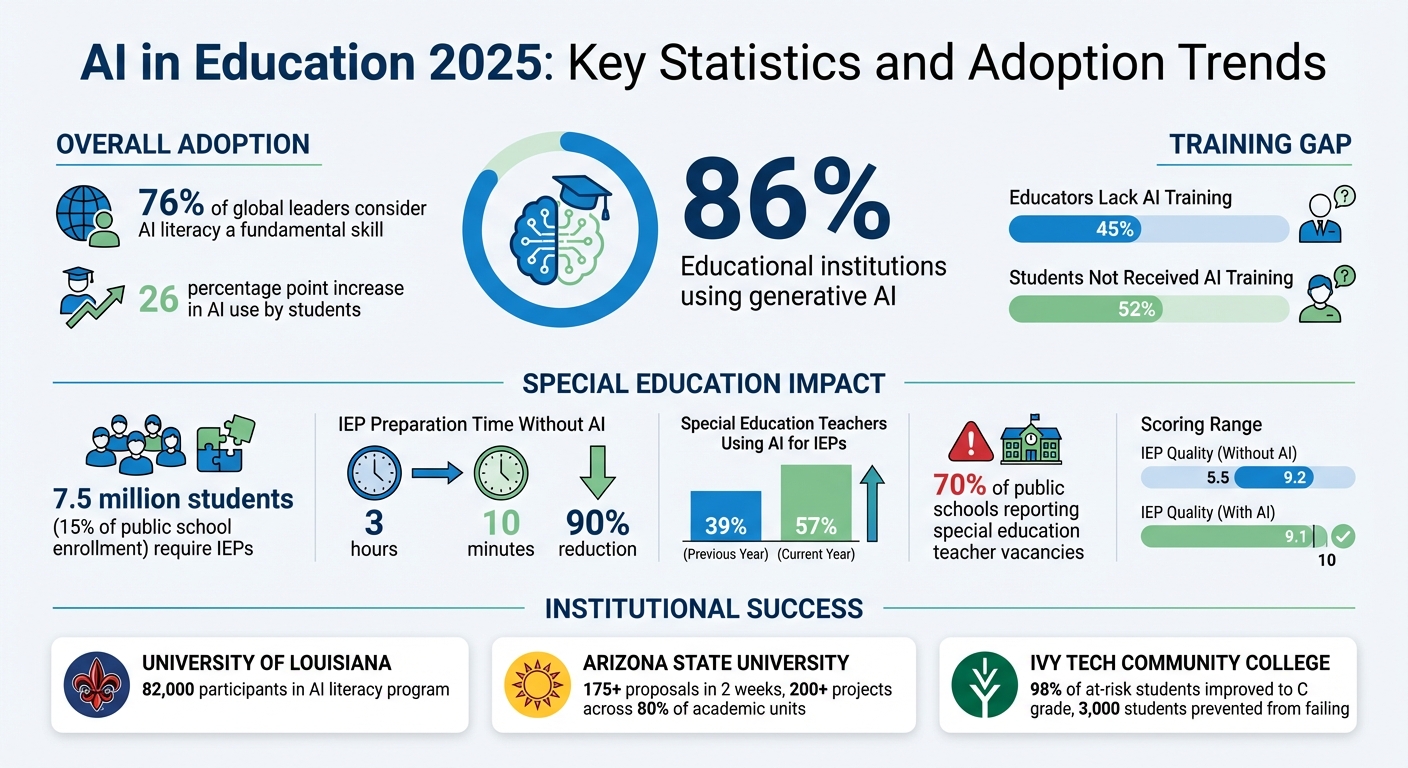
In 2025, AI reshaped education worldwide, with 86% of institutions using generative AI. Its role isn’t about replacing teachers but supporting them in areas like lesson planning, personalized learning, and reducing administrative tasks. Key insights include:
- AI adoption surged: Use by students rose 26 percentage points, with 45% of educators still lacking training.
- Special education benefited: AI reduced IEP preparation time by 90%, improving both efficiency and outcomes.
- Higher education embraced AI: Universities like ASU and Louisiana used AI for administrative tasks, student growth, and literacy programs.
- Challenges remain: Concerns about plagiarism and the training gap persist, highlighting the need for clearer guidelines.
AI’s presence in education is growing, but success depends on balancing human input with technological tools to improve learning experiences.
AI in Education 2025: Key Statistics and Adoption Trends
Scaling AI in Education: A Khanmigo case study: Shawn Jansepar
sbb-itb-e314c3b
AI Implementation Case Studies in Education
Three institutions in the United States have shown how AI can reshape education when applied with clear goals and strong support systems.
Lamont Elementary School District adopted Inkwire, an AI tool designed for competency-based project creation. This streamlined the process of designing projects and eased the workload for teachers, allowing them to focus more on teaching rather than planning.
The University of Louisiana System introduced a different initiative with its "Empowering AI Literacy for Students" programme, launched in spring 2025. This free, self-paced, 16-hour course - developed with state grant funding - has already reached 82,000 participants. The curriculum includes AI history, ethics, best practices, digital literacy, and data privacy. Upon completion, participants earn a digital badge to demonstrate their AI knowledge. Dr. Colleen Carraher Wolverton incorporated this microcredential into her "MGMT 455" course as extra credit. She noticed that students who were initially reluctant to use AI began applying it for practical purposes, such as drafting professional emails. Dr. Katie Dawson, Associate Vice President of Enrolment, Innovation, and Talent Strategy, highlighted the value of microcredentials:
"Microcredentials are a powerful way to recognise and validate learning that complements a student's degree. They highlight in-demand skills, such as project management, data analytics, or AI literacy, giving students credentials that align with workforce needs" [3].
Meanwhile, Arizona State University (ASU) launched its AI Innovation Challenge in February 2024. Within just two weeks, the initiative attracted over 175 proposals, and by July 2024, more than 200 projects were underway across 80% of ASU’s academic units [4][5]. Winners received four-month ChatGPT Edu licences, with IT and instructional design teams providing support. One standout project was the "Sam" chatbot, developed in the College of Health Solutions. This tool allowed students to practise patient-provider interactions, offering realistic scenarios to build motivational skills and deliver qualitative feedback. Clinical Professor Colleen Cordes praised its effectiveness, while ASU Chief Information Officer Lev Gonick shared a key insight:
"What we've learned at ASU is that if you want to focus on the impact of technology, start by asking the community what they want to solve for" [5].
Together, these examples highlight the importance of clear objectives and strong institutional support in making AI a meaningful part of the educational experience. The next section will explore the trends and lessons that have emerged from these initiatives.
AI in Special Education: Reducing Administrative Work
Special education teachers face a daunting administrative workload. During the 2022–23 school year, 7.5 million students in the United States - 15% of public school enrollment - required Individualized Education Programs (IEPs) [6]. These documents can stretch up to 50 pages, and with 70% of public schools reporting special education teacher vacancies in 2023–24, the pressure on remaining staff has become immense [6].
AI platforms are stepping in to ease this burden by automating "procedural compliance" - the extensive documentation that consumes hours of educators' time. In July 2025, Sanford-based company Better Speech introduced Streamline, an AI-powered platform for managing special education. The results? IEP preparation time dropped by 90%, shrinking from 3 hours to just 10 minutes. Speech-language pathology (SLP) teams also reported improved therapy efficiency and better outcomes for students [7]. CEO Ranan Lachman explained the mission behind this innovation:
"Our goal isn't just to save time - it's to give educators and therapy providers their purpose back" [7].
AI isn't just cutting time; it's improving the quality of IEPs. A study involving preschool educators revealed that teachers using AI to draft IEP goals scored between 9.1 and 10 on a 10-point quality scale, compared to a range of 5.5 to 9.2 for those working without AI [6]. Adoption of such technology is growing rapidly. By the 2024–25 school year, 57% of special education teachers were using AI to assist with IEPs or 504 plans, up from 39% the year before [8]. Beyond paperwork, AI tools are also delivering actionable insights.
For example, in early 2026, Rose Prust, a Special Education Teacher at Lopez Island School District, used AI tools like Magic School and Ablespace to refine IEP goals for students with complex needs. By analyzing interaction data through Ablespace, the AI discovered that a student with cortical visual impairment responded better to auditory cues than visual ones. This insight led to a shift towards multi-sensory instruction in the student's IEP, resulting in improved cause-and-effect comprehension within just one week [9].
Andrea Harkins-Brown, Program Director at Johns Hopkins University, highlighted the broader potential:
"If AI can help me with the procedural compliance, which is the nuts and bolts, then team members hypothetically have more time for what we call substantive compliance, which is making sure the document is a true reflection of what the child needs" [6].
This shift from administrative tasks to personalized support is transforming how educators allocate their time. AI's growing role in special education is enabling teachers to move beyond paperwork, focusing instead on delivering meaningful, tailored instruction to their students.
Key Trends and Lessons from 2025 AI Case Studies
The education landscape in 2025 shows what’s possible when institutions use AI with purpose and strategy. It’s no longer just about adopting new tools - real success is seen in areas like student retention, administrative efficiency, and tailored support.
One standout trend is the use of predictive analytics for early intervention. For example, Ivy Tech Community College in Indiana implemented an AI system to flag at-risk students within the first two weeks of the semester. The results were impressive: 98% of the students who received targeted interventions boosted their grades to at least a C, preventing 3,000 students from failing altogether[10]. This highlights how proactive measures, guided by AI, are changing outcomes for students.
Another clear advantage of AI is its ability to ease administrative burdens. At Georgia Institute of Technology, "Jill Watson", an AI-powered teaching assistant built on IBM’s Watson, managed most routine student questions in large-scale online courses. This drastically cut response times and allowed human teaching assistants to focus on more complex issues[10]. Similarly, Singapore’s Ministry of Education introduced automated tools to mark English assignments, assessing grammar, spelling, and syntax. This freed up teachers to focus on fostering creativity and critical thinking in their students[10]. These examples show how AI can handle repetitive tasks efficiently, but they also underline a critical gap: the need for better training.
Despite these advancements, a lack of AI training for educators and students remains a pressing issue. Surveys reveal that 45% of educators and 52% of students have not received any AI training, even as institutional leaders advocate for AI adoption[1]. Pat Yongpradit, Chief Academic Officer of Code.org and Lead of TeachAI, highlighted the importance of addressing this gap:
"Teachers are saying, 'I need training, it needs to be high quality, relevant, and job-embedded…' In reality, people require guidance and that means teachers and administrators going through professional development."[1]
The lesson here is clear: successful AI integration isn’t just about acquiring the right tools. It requires thoughtful implementation, clear policies, ongoing professional development, and a "human-in-the-loop" approach. By keeping educators at the heart of the process, AI can scale its benefits - handling routine tasks while enhancing personalised learning experiences.
RAISE Summit: Learning from AI in Education Case Studies

As the role of AI in education continues to grow, the RAISE Summit stands out as a key event for professionals eager to explore its potential. This annual gathering at the Carrousel du Louvre in Paris draws over 7,000 attendees, 2,000 companies, and more than 280 speakers, offering a unique opportunity for educators to dive into real-world AI applications. The summit provides not just theoretical insights but also practical tools and case studies to help institutions successfully integrate AI into their frameworks.
What sets RAISE Summit apart is its hands-on approach. Sessions focused on education include live demonstrations of tools like Socratic tutoring systems, with institutions such as MIT RAISE leading the way. These interactive showcases allow attendees to experience AI-powered teaching methods firsthand, bridging the gap between understanding the concept and applying it effectively.
Networking opportunities are another cornerstone of the summit. With participants from over 80 countries, educators can connect with peers to tackle common challenges in AI adoption. Discussions often revolve around overcoming infrastructure limitations, such as low bandwidth or reliance on feature phones in resource-constrained settings. The summit also emphasizes culturally responsive AI solutions, ensuring that technology aligns with diverse educational needs. As Cynthia Breazeal, Director of MIT RAISE, aptly stated:
"Whether you're a learner, a parent, a policymaker, AI and education now go hand in hand." [2]
Panel discussions at the summit delve into critical questions about pedagogy and AI. For instance, sessions like "AI for Creative Learning" explore which traditional teaching practices should evolve to meet the demands of a changing society. Professor Mitch Resnick highlights a key concern:
"Because AI could add some incremental advantages to what I see as outmoded approaches to pedagogy, it could reinforce them, re-entrench them, and not allow for the type of changes that we need for a changing society." [2]
These discussions aim to ensure that AI is used to innovate education rather than simply modernize outdated methods.
For those ready to take actionable steps, the summit offers flexible ticket options. The PRO pass (€999) grants full access to sessions, workshops, and networking events, while the VIP pass (€1,899) includes premium experiences and deeper industry connections. Emerging developers and startups can opt for a more affordable validated pass at €599, making the event accessible to a wide range of participants, regardless of their stage in AI adoption.
Conclusion: The Future of AI in Education
By 2025, AI has evolved from a supplementary tool to a central component of modern education, reshaping learning experiences while maintaining the indispensable role of educators.
These case studies highlight the need for AI integration that respects local contexts and prioritizes human-centered approaches. Success stories often share a focus on design that considers diverse needs and cultural nuances. Stefania Giannini, Assistant Director-General for Education at UNESCO, captures this sentiment perfectly:
"The future of education will be shaped by the policy choices that we make about education investment, about pedagogy, about governance and about the ethical principles we uphold" [12].
This shift is steering education away from one-size-fits-all, English-dominated models toward systems that embrace linguistic and contextual diversity. Projects like Rwanda's WhatsApp-based RAISE initiative and France Éducation International's multilingual Cybèle chatbot are excellent examples of this localized approach. The numbers speak volumes: 86% of educational organizations now use generative AI, and 76% of global leaders consider AI literacy a fundamental skill for basic education [1].
However, there’s still a pressing need to close the training gap. Collaborative platforms and professional development opportunities are vital to ensuring AI serves as a creative ally rather than a source of stress or confusion for educators.
The future focus must move beyond simply adopting AI to fully embedding it in ways that enhance creativity and critical thinking. Initiatives like the Day of AI curriculum, which reached over 2 million students across 175 countries in 2025 [11], illustrate how AI fluency is becoming a foundational skill for the next generation. As Ana Lucía Pérez, a 10th-grade student from Puerto Rico, wisely points out:
"Change doesn't start with perfection. It starts with curiosity and courage" [2].
For educators, this means embracing lifelong learning and innovative strategies to unlock AI’s full potential. Thoughtful integration and consistent professional growth will remain key to ensuring AI drives meaningful progress in education.
FAQs
How do schools train teachers for AI fast?
Schools are adopting focused, efficient approaches to help teachers get up to speed with AI. These include online training programs aimed at improving AI understanding, industry-sponsored hubs designed to quickly develop specific skills, and pilot projects where educators test AI tools directly in their classrooms. Additionally, professional development sessions are offered to ensure teachers can effectively use these tools in real-world teaching scenarios. The emphasis is on providing practical, easy-to-access training, so educators can seamlessly incorporate AI into their teaching methods.
How can AI cut admin work without risking student data?
AI tools are transforming administrative tasks in education by making them more efficient while prioritizing student data protection. For instance, secure, FERPA-compliant solutions utilize advanced Data Loss Prevention (DLP) technology to redact and safeguard sensitive information. These tools handle tasks like grading and scheduling, freeing up valuable time for educators and staff.
To maintain both security and efficiency, these systems integrate features like encryption, access controls, and audit trails. This ensures that compliance with privacy regulations is upheld without sacrificing productivity.
How do institutions prevent AI plagiarism and misuse?
Institutions are tackling the challenges of AI plagiarism and misuse by combining detection tools, clear policies, and education initiatives. AI detection tools are used to spot machine-generated content, though their accuracy can sometimes be inconsistent. To address this, many institutions place emphasis on educating students about the ethical use of AI and creating assessments that make misuse less tempting. By focusing on these strategies, they aim to encourage transparency, responsible behaviour, and academic integrity, rather than relying solely on punitive actions.