

AI hackathons are fast-paced events where teams build and pitch AI solutions within tight deadlines (24-48 hours). Success depends on choosing the right tools for planning, development, collaboration, and pitching. Here’s what you’ll need:
- Planning & Management Tools: Platforms like DoraHacks BUIDL AI 3.0, HYPE Innovation, and Eventornado simplify event setup, registration, judging, and communication.
- Development & Prototyping Tools: Tools like Momen (no-code backend), Figma AI (UI design), and n8n (workflow automation) save time and effort in creating functional prototypes.
- Collaboration Platforms: HackerEarth, Devpost, and Ideanote help teams stay aligned and manage submissions effectively.
- Presentation Tools: Gamma generates polished pitch decks in minutes, helping teams deliver standout presentations.
Key Takeaway: The right tools help teams focus on building functional prototypes and delivering impactful pitches, ensuring hackathon success.
How to Build Winning AI Projects: Tools from Hackathon Experts
sbb-itb-e314c3b
Planning and Management Tools
Organising an AI hackathon involves juggling registration, submissions, judging, and communication - all within tight timeframes. Fortunately, modern management platforms can automate many of these tasks, cutting down hours of work to just minutes. These tools, often powered by AI, simplify everything from setting up event pages to screening submissions. Below, we explore some of the top platforms that make planning and managing hackathons more efficient.
DoraHacks BUIDL AI 3.0
DoraHacks has been a key player in the hackathon space, supporting over 700 events since 2019 [5]. Its BUIDL AI 3.0 platform uses AI to create hackathon pages in minutes, covering tracks, timelines, prize pools, and descriptions. It also automates submission reviews, assessing relevance, originality, and completeness, which reduces manual setup by about 80% [4][5]. Submissions that meet a pre-set quality score (e.g., 60/100) can be automatically approved, saving organisers even more time [4][5].
When it comes to judging, the platform ranks projects based on weighted criteria and provides reasoning to assist human judges in making final decisions [4][5]. To ensure fairness in high-stakes competitions, DoraHacks employs aMACI (anonymous Minimal Anti-Collusion Infrastructure), an on-chain judging system [4].
Communication is another area where DoraHacks shines. Features like Smart Auto-Reply and integrated Telegram bots provide round-the-clock responses and real-time notifications for participants [4][5][7]. After the event, the platform’s marketing tools generate ready-to-share summaries of winners and achievements for platforms like X and LinkedIn [4][7]. Impressively, over 30,000 startup teams in the DoraHacks community have secured more than 92 million € in funding [5].
HYPE Innovation
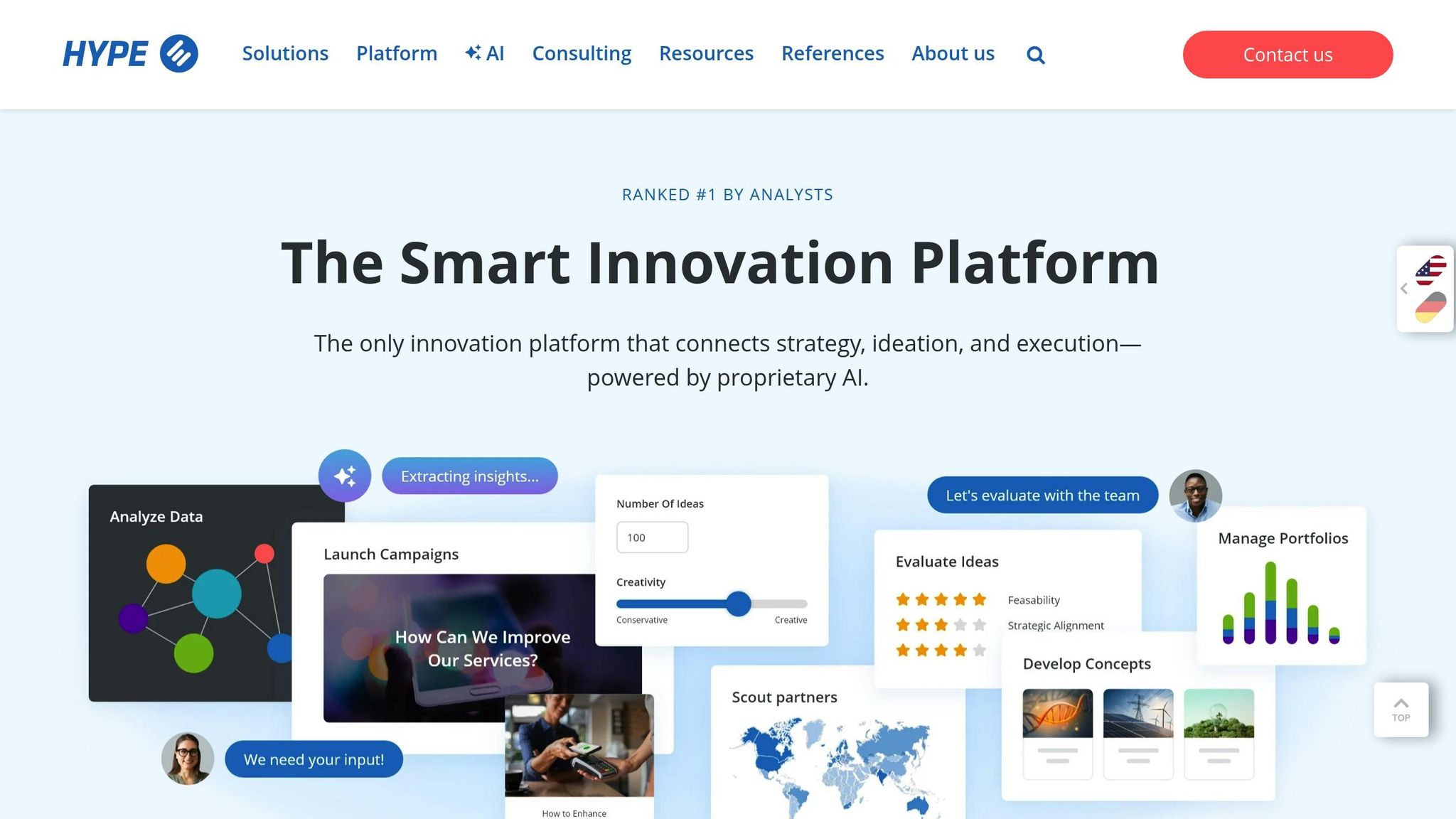
HYPE Innovation caters to corporate needs, offering tools designed for internal AI challenges and innovation programs. It focuses on idea collection, evaluation scoring, and analytics, making it ideal for organisations looking to foster innovation. The platform’s customisable judging rubrics and voting systems ensure a structured and transparent evaluation process [8].
Its dashboards provide detailed metrics to track engagement and justify results to stakeholders. Additionally, an idea gallery allows participants and judges to review submissions easily, promoting transparency and collaboration [8].
Eventornado
Eventornado has facilitated more than 200 events with 50,000 participants, generating approximately 7,000 ideas [6]. Its scalability - from 10 to 10,000 participants - makes it versatile for both small and large events. The platform provides an all-in-one solution for online, in-person, and hybrid hackathons, eliminating the need for multiple tools like spreadsheets and separate chat apps [6].
Eventornado manages the entire participant journey, from registration to team formation, all within the same platform [6]. Its customisable judging workflows allow organisers to adapt evaluation processes to specific needs while maintaining a clear audit trail of event activities [6]. For organisations focused on brand consistency, the platform also offers white-labelling options [8].
"For a hackathon we were hosting simultaneously in four countries in West Africa, bringing Eventornado on board with us was the best decision we could have made." – Ricky, Pact [6]
The platform’s built-in chat integrates with Slack, Discord, and Microsoft Teams, centralising participant communication [8]. Engagement analytics and outcome tracking further help organisers evaluate what worked and demonstrate value to sponsors and stakeholders [6].
With these tools in place, organisers can shift their focus to the next big step: development and prototyping tools to bring ideas to life.
Development and Prototyping Tools
Once efficient planning is in place, the next big step in hackathons is quick prototyping. Time is always tight, so using tools that simplify backend setup and UI styling can make all the difference. The right platforms can eliminate repetitive tasks, allowing participants to focus on creating a functional and impressive prototype. In hackathons, where every hour matters, these tools often determine whether a project is presentation-ready or left incomplete.
Momen
Momen is a full-stack no-code platform and Backend-as-a-Service (BaaS) that simplifies backend development. It offers features like visual database builders, user authentication, and API logic, enabling teams to handle tasks like logins, data storage, and API setup in just minutes instead of hours or days [1]. This speed is critical, as technical implementation, including data modeling and workflow, often accounts for up to 35% of the total scoring criteria in hackathons [9].
Teams can use Momen to build an entire app or just the backend, pairing it with other frontend tools. For example, during an AI Bootcamp in January 2026, participants used Momen to create "Smooth Operator", an AI-powered tool that automates moving-related tasks like finding movers and negotiating prices. The platform's ability to handle authentication early in the process ensures that personalisation features can be integrated seamlessly into the project, enhancing the final presentation [1][10].
"Momen is full-stack web app builder. But you can choose it to build your hackathon backend. You will save hours and impress judges with a real, working app." – Momen Blog [1]
While Momen handles backend tasks, tools for design and workflow automation are equally important for rapid prototyping.
Figma AI
Figma AI revolutionizes UI prototyping by transforming basic sketches into high-fidelity mockups using its "Make Design" feature. Tasks that might take hours, such as creating patient information dashboards, can now be completed in minutes [1]. This speed allows non-technical team members to play an active role in development, freeing up developers to concentrate on more complex AI logic. In one recent project, teams used Figma AI to design a "Pharmacy AI Copilot" and a "Telemedicine Tool", cutting interface development time significantly [1].
n8n
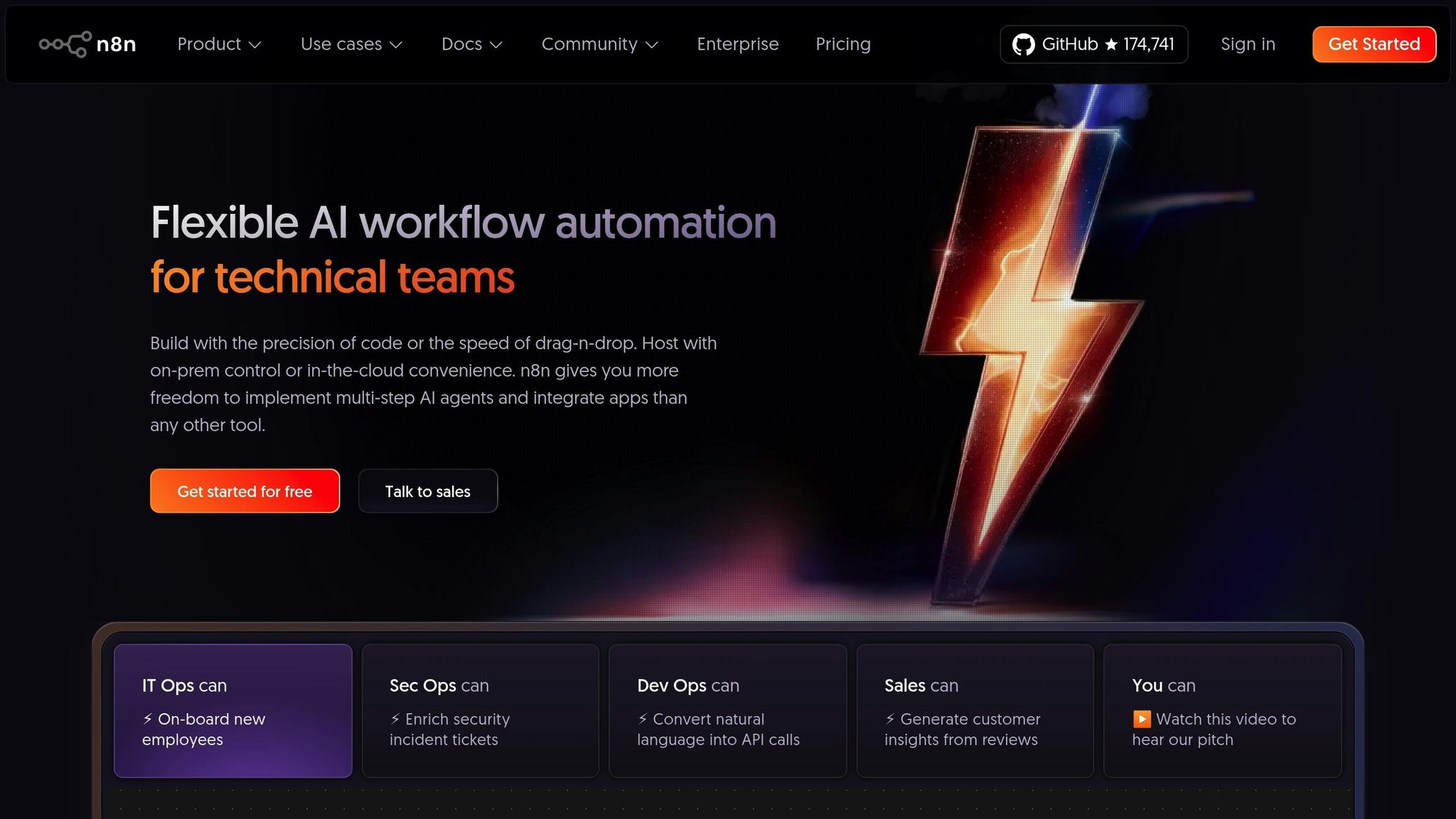
n8n is a drag-and-drop automation builder designed to connect AI applications with more than 400 external services [1]. Instead of writing lengthy integration code, teams can use its visual workflows and webhooks to link APIs and automate tasks like sending notifications through platforms like Slack, Discord, or Gmail. This approach makes it easy for anyone on the team to manage integrations without needing advanced coding skills.
For example, during a 2026 hackathon, a team used n8n to build a customer support agent. The tool automated ticket handling and draft reply generation by connecting various communication services, saving hours of manual coding [1]. While n8n offers a free version with limited tasks, similar automation tools often start at around €18.99/month [2]. By simplifying workflows and automations, n8n helps teams allocate their time more efficiently.
| Tool | Primary Function | Key Feature | Setup Time |
|---|---|---|---|
| Momen | Backend & Data Management | Visual DB builder, User Auth, AI Agents | Minutes |
| Figma AI | UI/UX Prototyping | "Make Design" UI generation, rapid mockups | Minutes |
| n8n | Workflow Automation | 400+ integrations, drag-and-drop builder | Minutes |
With backend tasks streamlined by Momen, Figma AI speeding up UI design, and n8n simplifying integrations, teams can focus on building polished and functional prototypes in record time.
Collaboration and Communication Platforms
Once planning and prototyping are in place, effective communication and collaboration become the backbone of a successful hackathon. Smooth coordination among participants, mentors, and organizers ensures everything runs seamlessly. The right platforms can centralize key activities like registration, team building, project submissions, and judging, all while minimizing administrative hurdles. Real-time communication tools and dedicated spaces for discussions help resolve technical issues quickly, and public project galleries keep the momentum alive even after the event ends. With prototyping taken care of, strong collaboration ensures ideas turn into meaningful outcomes [11][12].
HackerEarth
HackerEarth simplifies team collaboration and project management. It also offers integrated tools for evaluation and features its standout VibeCode Arena - a unique space where developers can test their AI coding skills by challenging multiple Large Language Models (LLMs) [13].
Devpost
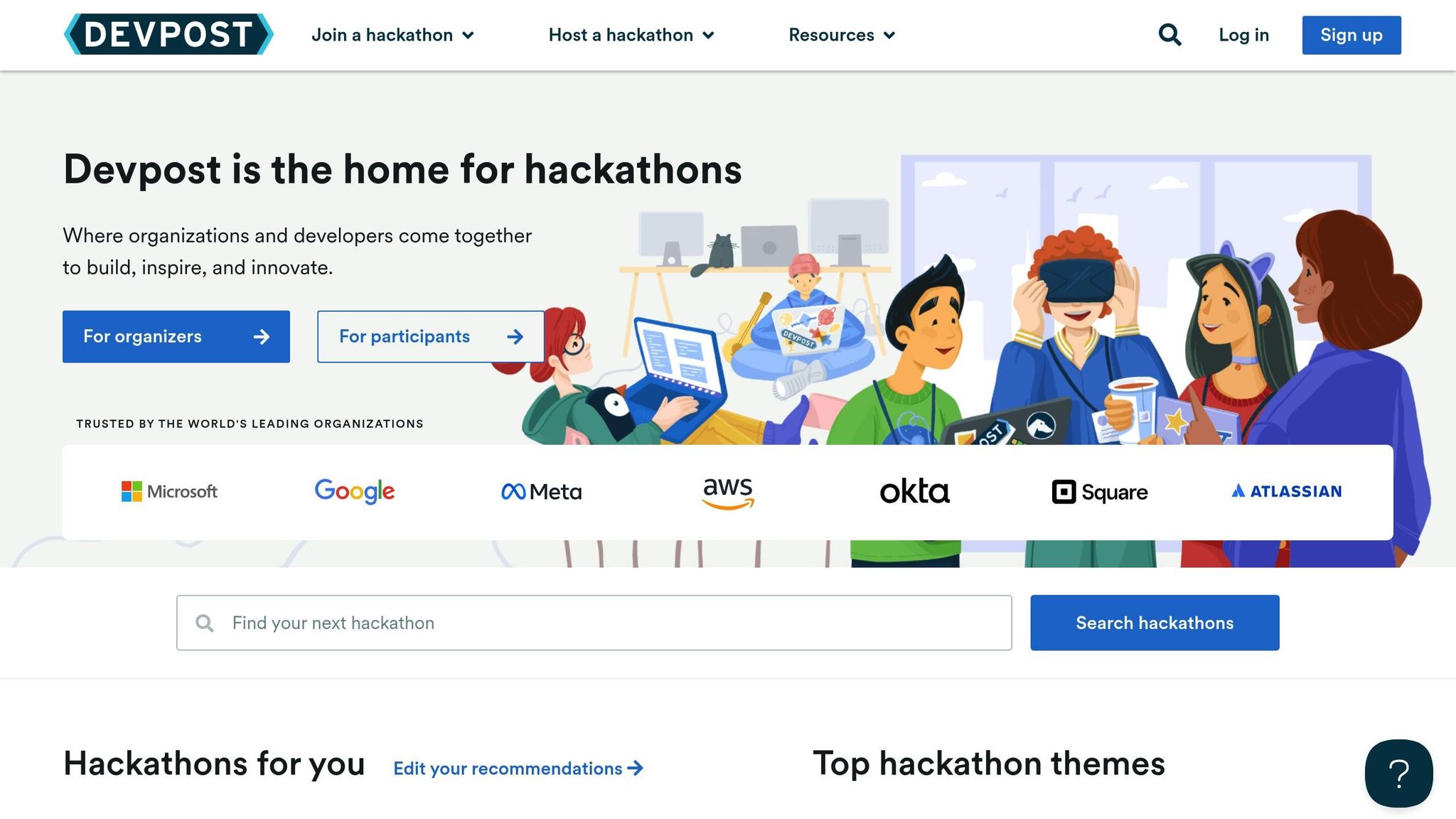
Devpost connects a massive community of over 4 million developers and has supported more than 10,000 hackathons worldwide [14]. It's especially effective for managing large virtual AI hackathons by combining registration, submissions, and project showcasing into one platform. A notable example is Finastra's 2020 virtual hackathon, which brought together over 4,000 participants and kept engagement high post-event through its project gallery [12]. For virtual hackathons, timelines often include a 6- to 8-week registration and submission phase, followed by a 1- to 2-week judging period [12].
Ideanote
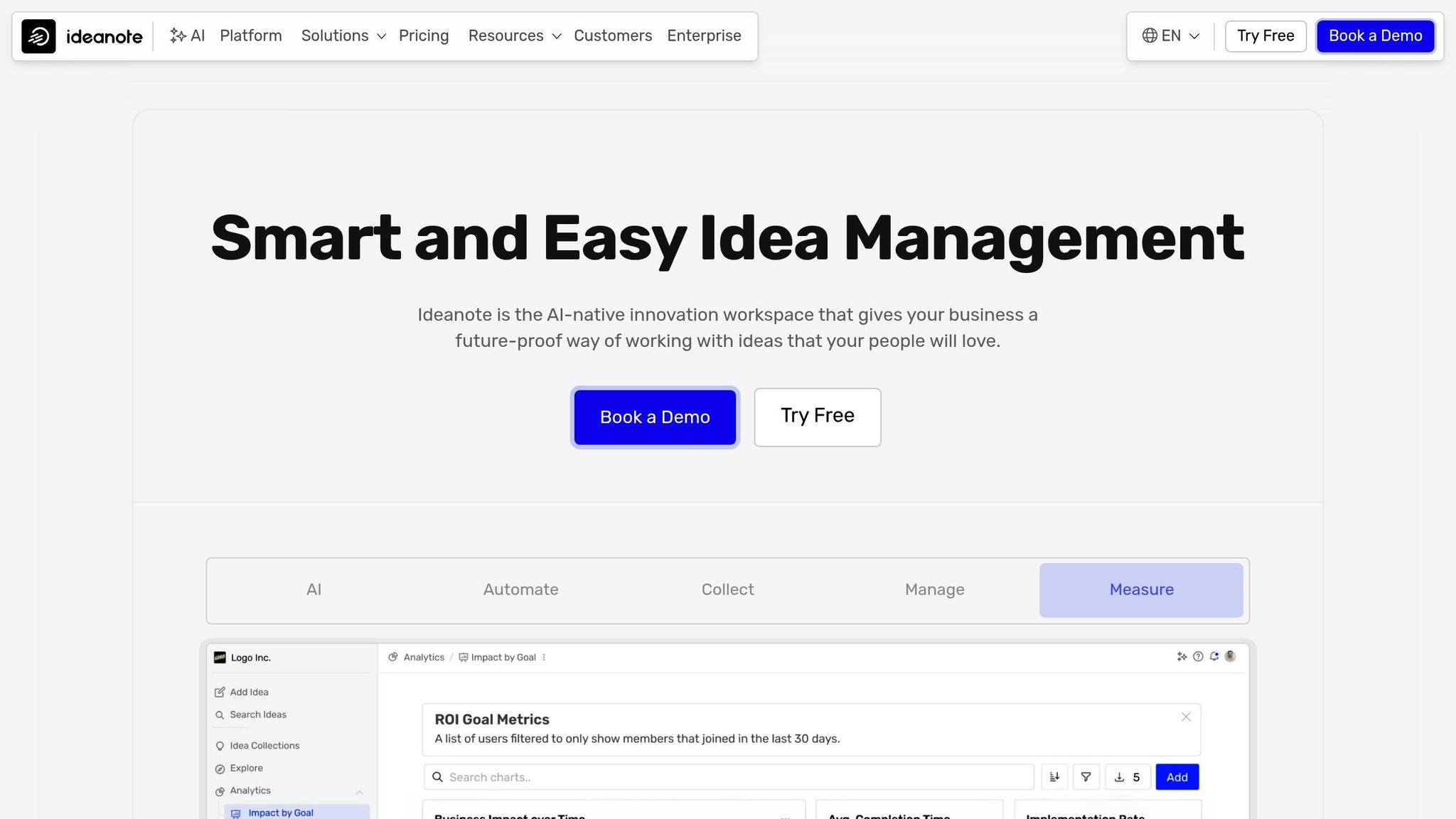
Ideanote focuses on streamlining submission management, tracking analytics, and automating workflows. Its built-in tools simplify the judging process by sending instructions and scoring dashboards directly to judges, making evaluations hassle-free [11]. The platform’s automation reduces manual tasks, while its analytics tools spotlight the most engaging projects.
Presentation and Pitching Tools
Once the prototype is ready, the next step is delivering a pitch that truly stands out. A well-crafted pitch deck can make all the difference between an idea that gets ignored and one that grabs attention. Choosing the right presentation tool can help teams simplify complex ideas into clear, visually engaging stories - without the headache of design struggles. Here’s how Gamma makes the process easier and faster.
Gamma
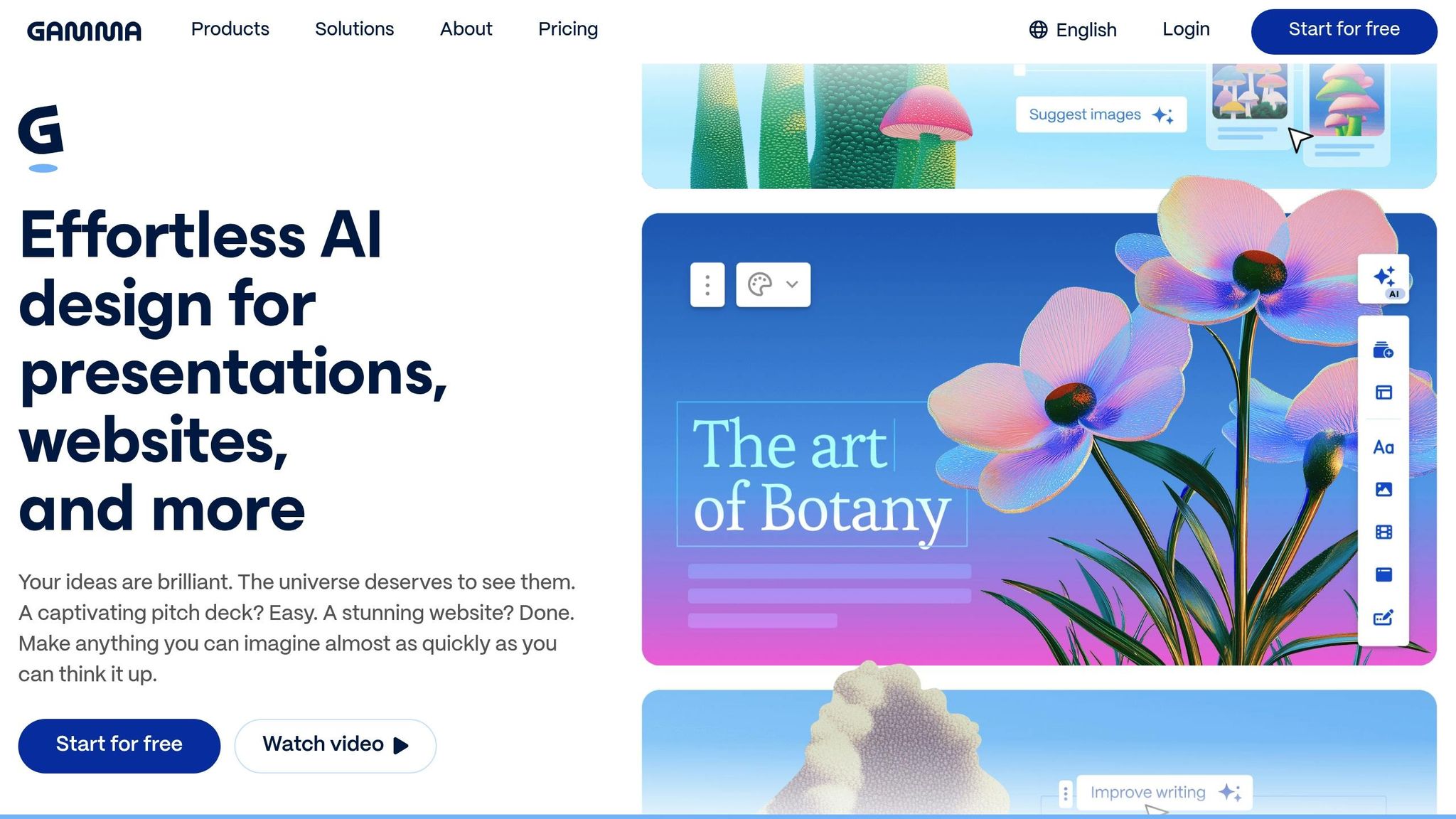
Gamma uses AI to create polished pitch decks in just 2–3 minutes [16]. Instead of staring at a blank slide, users can provide a simple text prompt, an outline, or even documentation. From there, the platform generates a complete, structured deck with smart layouts, consistent branding, and AI-designed visuals. This approach eliminates the stress of starting from scratch, allowing teams to focus on perfecting their message rather than fussing over design details.
What sets Gamma apart is its card-based, web-native format. The result? A responsive, scrollable presentation that works seamlessly across devices. Teams can also embed live content like demos, GIFs, and polls, while the Spotlight feature ensures the audience stays focused on key points. Plus, real-time collaboration means multiple team members can tweak and refine the deck right up until the final moments before presenting.
"Gamma has become an essential tool for all of my work. The ability to create presentations and make adjustments quickly with simple prompts or the click of a button has given me hours of my life back!" - Aaron Baughman, AI Strategist, Michigan Virtual [15]
Gamma also offers advanced settings to customize the pitch. Teams can specify their audience - whether it’s venture capitalists or technical judges - and choose a persuasive tone before generating the deck. The AI editing agent makes it easy to refine the presentation further, allowing users to adjust images or messaging with simple chat commands, all without needing to manually reformat.
With more than 70 million users [16] and 250 million presentations already created [15], Gamma has become a trusted tool for delivering standout pitches under tight deadlines. The free plan provides 400 credits (around 10 presentations), while paid plans start at just €8 per month when billed annually [16].
Tool Comparison Table
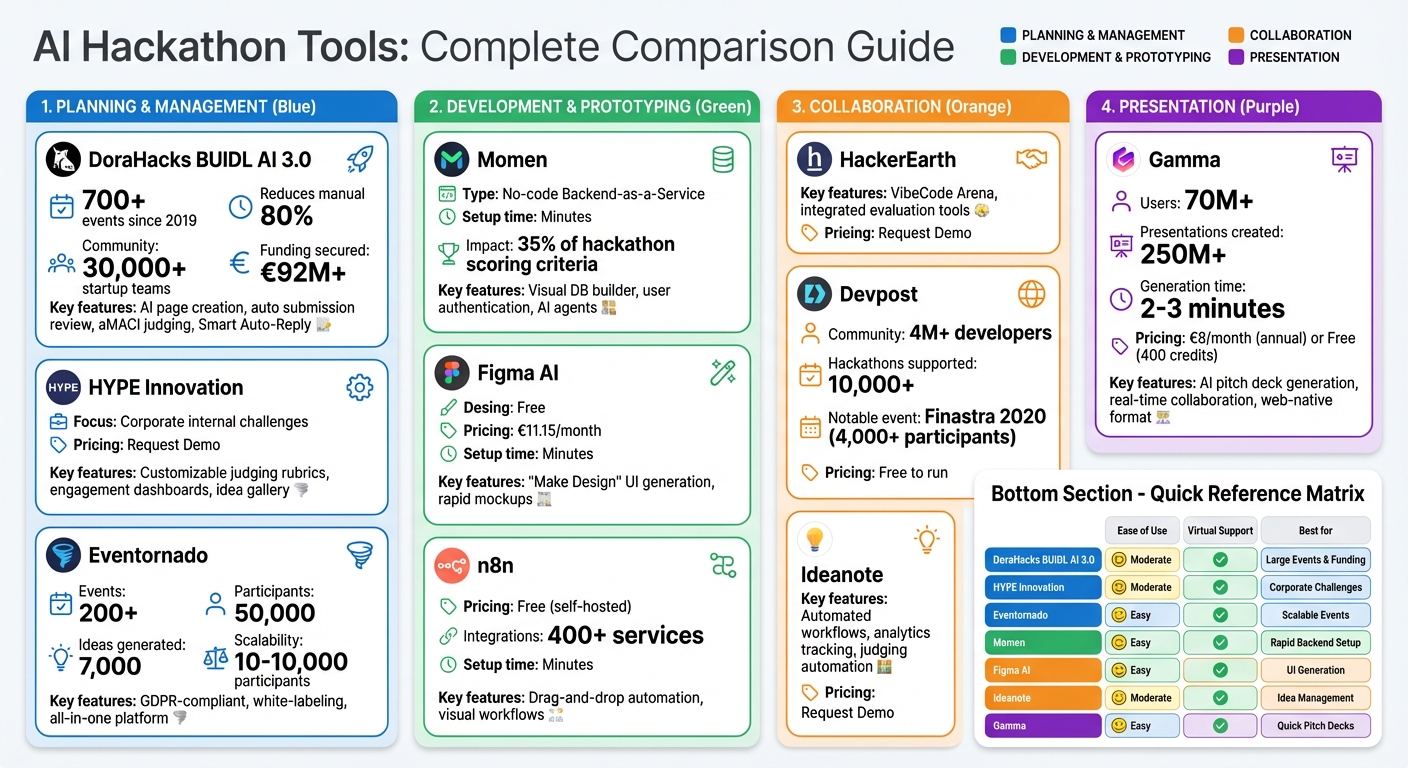
AI Hackathon Tools Comparison: Features, Pricing, and Best Use Cases
Choosing the right tools for a hackathon means balancing features, cost, and usability. Below is a summary table that highlights essential tools, helping organisers quickly evaluate options for planning, development, and collaboration.
| Tool | Category | Pricing (€ Approx.) | AI-Specific Function | Ease of Use | Virtual Support |
|---|---|---|---|---|---|
| HYPE Innovation | Planning & Management | Request Demo | AI-augmented brainstorming | Moderate | 1:1 Support |
| Eventornado | Planning & Management | Request Demo | GDPR-compliant registration | Easy | 1:1 Support |
| Momen | Development | Request Demo | AI agents & visual backend | Easy | Seamless backend integration |
| Figma AI | Prototyping | €11,15/month | "Make Design" UI generation | Moderate | Plugin ecosystem |
| n8n | Automation | Free (self-hosted) | AI-integrated workflows | Easy | Community support via GitHub |
| HackerEarth | Collaboration | Request Demo | Idea gallery & live coding | Moderate | Dashboard support |
| Devpost | Collaboration | Free to run | Project gallery for 4M+ developers | Easy | Community support |
| Ideanote | Collaboration | Request Demo | Algorithmic team formation | Moderate | Workspace integration |
| Gamma | Presentation | €8/month | AI pitch deck generation | Easy | - |
For organisers in France, Codabench and CodaLab, managed by LISN staff at the University of Paris-Saclay, are standout options. These platforms are completely free and open-source, boasting a user base of 50,000 within 2.5 years and hosting 71 competitions in 2023 alone [17][18]. They offer an excellent solution for academic and research events with zero licensing fees.
GDPR compliance is a key consideration for events in France. Tools like Eventornado ensure full GDPR compliance, making them a safe choice for organisers [8]. For technical support, platforms like n8n and Devpost offer community-driven resources, including GitHub repositories and forums, ideal for quick troubleshooting during a hackathon.
For teams focused on rapid prototyping, free-tier services like Hugging Face Spaces, Google Colab, or Render.com allow hosting AI demos without upfront costs [3]. This is particularly useful for shorter hackathons where budgets are tight.
When selecting tools, think about your hackathon's specific needs. For real-time collaboration, consider Figma AI or Gamma. If automation is a priority, n8n is a strong pick. For showcasing projects and ensuring long-term visibility, Devpost offers access to a vast developer community. Tailor your choices to match the scale, complexity, and format (virtual or in-person) of your event. This table provides a starting point to help refine your tool selection as you finalise your setup.
Conclusion
Choosing the right tools for a hackathon can make or break your team's success. The difference between a polished demo and a project that falls short often lies in selecting tools that eliminate obstacles. As Sparks Dela Rosa from Momen Technologies aptly states:
"Hackathons are not about using every tool. They are about choosing the right tools for your problem" [1].
For organisers, the focus should be on creating a tech stack that aligns with participants' expertise and the event's format. Large-scale events with over 500 participants might benefit from enterprise platforms like HackerEarth, while smaller events can explore more affordable options. The tools should facilitate seamless data management and real-time feedback, with robust SQL/NoSQL integration to monitor engagement effectively. Combining these tools with strong planning and prototyping ensures the event runs smoothly.
Participants, on the other hand, should aim for a balance between speed and functionality. Leveraging AI coding assistants and no-code backends can cut production time by as much as 70% [1]. Training a pre-built model on a free cloud GPU can achieve over 85% accuracy in less than an hour [3]. Deploying an initial working version within the first four hours is crucial to identify and resolve configuration issues early on [10]. This strategy complements the organisers' efforts, ensuring both parties reach their objectives.
The trend toward production-ready demos means judges now expect more than just slides - they want live URLs and functional data persistence. Using trusted tools for design, automation, and project showcasing can help your project leave a lasting impression. Whether you're tackling a 24-hour sprint or a multi-day challenge, the right tools can transform your ideas into tangible, working prototypes.
FAQs
Which tools do I need for a 24–48 hour AI hackathon?
For a 24–48 hour AI hackathon, having the right tools can make all the difference. Start with cloud-based environments like Deepnote to collaborate with your team in real time. To speed up your coding process, leverage AI coding assistants such as ChatGPT or GitHub Copilot. Need GPU power? Platforms like RunPod offer on-demand resources to handle heavy computations.
Don’t overlook brainstorming and project organization. Tools like Gemini can help you manage tasks efficiently and generate project ideas quickly, keeping your workflow smooth and focused.
How can we build a working AI demo (with a live URL) fast?
To set up a quick AI demo with a live URL, tools like Gradio can make the process straightforward. Start by installing it using pip install gradio. Then, define your model's input and output using either the Interface or Blocks API. Once that's ready, launch a local server with interface.launch(). To make it accessible, enable the sharing option, and you'll get a live URL that can be accessed from anywhere.
This approach is perfect for situations like hackathons or quick presentations since it only requires a few lines of Python code to get up and running.
What should organisers prioritise for GDPR-compliant hackathons in France?
Hackathon organisers in France need to ensure they follow GDPR regulations to safeguard participants' personal information. Here are the key steps:
- Conduct a Privacy Impact Assessment (PIA): This helps identify and mitigate risks associated with data processing.
- Limit Data Collection: Only gather information that is strictly necessary for the event's purpose.
- Obtain Explicit Consent: Participants must clearly agree to how their data will be used.
Organisers should also provide clear information about how personal data will be stored, shared, and used. Transparency is key - maintain detailed records of data processing activities and implement strong security measures to protect against breaches. Following these steps not only builds trust with participants but also helps avoid legal troubles or hefty fines.