


Want to make AI work for your business? Here's the big takeaway: most companies struggle with AI, but those that succeed see faster growth and better results. The key? Focus on three areas: aligning AI with business goals, ensuring strong data practices, and building a culture that supports AI adoption.
Quick facts to know:
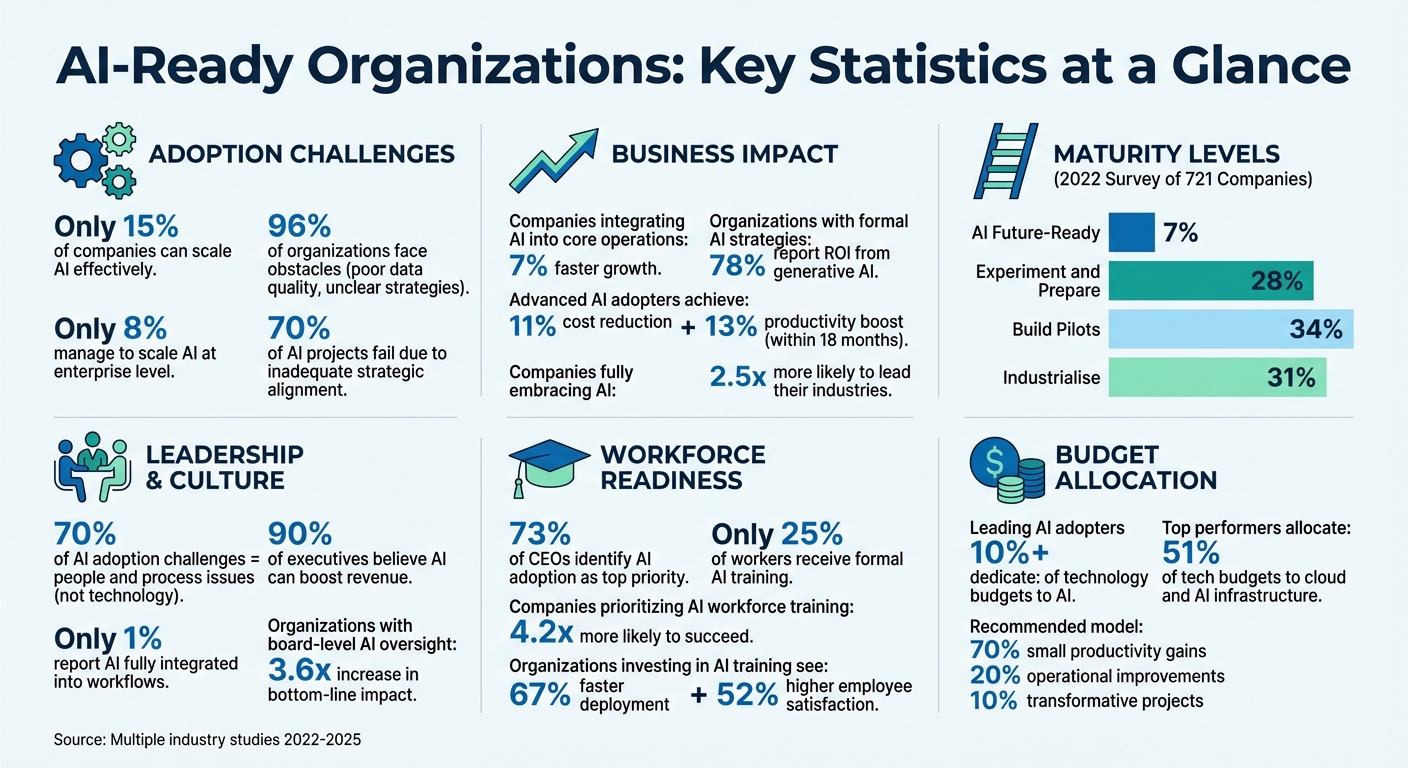
- Only 15% of companies can scale AI effectively.
- 96% face obstacles like poor data quality and unclear strategies.
- Companies that integrate AI into their core see 7% faster growth.
What you’ll learn:
- How to assess your AI readiness with tools like the MITRE AI Maturity Model.
- Why strong data infrastructure and governance are non-negotiable.
- How leadership, training, and collaboration drive AI success.
- Practical steps to align AI projects with business goals and measure ROI.
- Tips for overcoming resistance and managing budgets.
Ready to get started? Let’s break down how to make your organization AI-ready step by step.
AI Adoption Statistics and Organizational Readiness Key Metrics
Stop Guessing: Build an AI-Ready Organisation That Can Actually Deliver
sbb-itb-e314c3b
Evaluating Your Organisation's AI Maturity
Before diving into AI investments or hiring specialized staff, it’s crucial to take a step back and evaluate where your organisation stands in terms of people, processes, and technology. This assessment can help pinpoint gaps and ensure your efforts are focused on areas that will deliver the most impact.
A 2022 survey of 721 companies revealed some telling insights: only 7% of organisations were classified as "AI Future-Ready." Meanwhile, 28% were still in the "Experiment and Prepare" phase, 34% were in the "Build Pilots" stage, and 31% had reached the "Industrialise" stage [7]. Interestingly, companies in the more advanced stages (Stages 3 and 4) tend to outperform their industry peers financially, while those in the earlier stages often lag behind [7].
Running an AI Maturity Audit
To understand your current position, start with a structured framework. The MITRE AI Maturity Model is a comprehensive tool that evaluates 20 dimensions across six pillars, including Strategy and Resources, Organisation, Technology Enablers, Data, and Performance and Application [6]. If you're looking for a quicker option, Microsoft's AI Readiness Assessment takes about 45 minutes and assesses seven pillars, such as Data Foundations and Infrastructure for AI [8].
"AI is meant to be experiential for all levels of an organization." - MITRE Corporation [6]
These assessments provide an objective score, comparing your current state to your target maturity level. For example, Gartner’s model focuses on seven core areas - strategy, product, governance, engineering, data, operating models, and culture - and offers a baseline along with a customised roadmap [9].
Stephanie Woerner, Director at MIT CISR, emphasises the importance of these tools:
"Enterprises can use the MIT CISR Enterprise AI Maturity Model to assess their current capabilities, identify gaps, and create a road map for improvement across various dimensions, such as processes, technology, and organizational culture" [7].
The goal is to move from ad hoc, heroics-driven processes (Level 1) to more structured, governed systems (Level 3), where processes are consistent, and decision-making is clearly defined.
Once you’ve established your maturity scores, the next step is to focus on your data infrastructure, which forms the backbone of any successful AI initiative.
Reviewing Data Infrastructure Strengths and Weaknesses
With your maturity audit as a starting point, take a closer look at your data infrastructure. This will determine whether your AI initiatives thrive or hit roadblocks. Key areas to evaluate include data quality, accessibility, and governance.
Poor data quality - such as incomplete records, inconsistent formats, or outdated information - can derail even the most advanced AI models. Accessibility can also be a major hurdle if data is siloed across departments, requiring manual extraction and integration. On top of that, weak governance can lead to compliance risks and ethical concerns.
Maturity models like MITRE and Gartner provide scoring rubrics that can help you objectively assess your data infrastructure. For example, MITRE includes a dedicated "Data" pillar within its 20 dimensions, while Gartner evaluates data as one of its seven core areas [6][9]. These tools can help you identify critical improvements, such as consolidating siloed data or automating data pipelines, that will make your organisation more AI-ready.
Peter Weill, Senior Research Scientist at MIT, points out a key challenge many organisations face:
"The hardest part of Stage 2 is changing. How do we move from a command-and-control culture to a coach-and-communicate culture?" [7].
This cultural shift is just as important as technology upgrades. By fostering a culture that enables front-line decision-making and self-service through better data access, organisations can transition from manual, fragmented processes to automated, industrialised systems.
Connecting AI Strategy with Business Objectives
After assessing your organisation's AI maturity and data infrastructure, the next step is crucial: aligning AI initiatives with your business goals. Without this connection, projects risk falling short. A study highlights this point - 78% of companies with formal AI strategies report seeing ROI from generative AI [11].
To achieve this, combine top-down and bottom-up alignment. Senior leadership can set overarching priorities like reducing costs or improving customer satisfaction, while teams on the ground identify specific challenges where AI can make a difference.
Raymond Peng, Senior Principal for AI Value Creation at Google Cloud, explains:
"A single AI implementation isn't likely to move the financial needle on its own... The most significant impact typically comes from multiple use cases that can work together to reimagine the entire chain of value." [11]
How resources are allocated also plays a big role. Research suggests a "10-20-70" model: dedicate 70% of efforts to small productivity gains (like automating repetitive tasks), 20% to operational improvements (such as supply chain optimisation), and 10% to transformative projects that could redefine your business [13]. This approach ensures a balanced focus on both immediate and long-term value.
Setting AI Vision and Core Principles
Strategic alignment starts with a clear AI vision. This means defining why your organisation is investing in AI - not just what you want to create. Tie this vision to measurable goals, whether it's driving innovation, cutting costs, or enhancing customer experiences.
Principles like fairness, reliability, privacy, and accountability should guide your projects [12]. For example, if transparency is a priority, you might choose explainable AI models over more opaque alternatives, even if the latter perform slightly better.
Toby Bowers, Vice President of Commercial Cloud & AI Marketing at Microsoft, notes:
"Success looks different from one organisation to the next - and what it looks like may change over time depending on your unique business challenges and objectives." [10]
Documenting your AI vision and principles ensures consistent decision-making across departments. Many organisations also appoint a Chief AI Officer (CAIO) to maintain alignment across all business units as they scale their AI efforts [10].
Selecting Use Cases and Assessing Risks
With a clear vision in place, the next step is choosing the right AI projects. Use cases should align with your business goals and reflect your organisation's data and AI readiness. A prioritisation matrix can help by evaluating potential projects based on Business Value (impact, strategic alignment, scalability) and Actionability (data availability, technical feasibility, speed to implementation) [11]. Focusing on high-value, high-feasibility projects can deliver early wins and build momentum.
For each use case, define:
- Goal: The overarching purpose of the project.
- Objective: The specific outcome you're aiming for.
- Success Metric: Quantifiable targets to measure progress [12].
At the same time, conduct a risk assessment. The NIST AI Risk Management Framework categorises risks into three areas:
- Data and Model Risks: Issues like adversarial attacks or prompt injection.
- Operational Risks: Challenges such as model drift or performance degradation.
- Ethical/Legal Risks: Concerns about bias, hallucinations, or regulatory compliance [14].
A structured approach to metrics is also essential. For example:
| Area | Metrics | Purpose |
|---|---|---|
| Model Quality | Accuracy, reliability, security | Evaluates technical performance and responsible AI practices |
| System Metrics | Performance, compute cost, latency | Monitors infrastructure efficiency and scalability |
| Adoption Metrics | Usage frequency, user feedback | Tracks workforce integration and adoption |
| Operational Metrics | Click-throughs, time-to-task | Measures impact on business processes |
| Business Impact | Revenue growth, cost reduction | Demonstrates financial outcomes tied to strategic goals |
Establishing a baseline for these metrics before launching projects allows for accurate A/B testing and ROI calculations [11].
For more insights, consider attending industry events like the RAISE Summit, happening 8–9 July 2026 at the Carrousel du Louvre in Paris. The event's "Friction" track focuses on ROI challenges and value realisation, offering a chance to learn from peers [2][3].
Finally, decide whether to build custom AI solutions or use commercial platforms. Custom solutions are ideal for competitive differentiation or when leveraging proprietary data. For more standard tasks like HR or expense processing, commercial platforms may be more practical. Partnering with specialists can also help navigate complex projects and mitigate risks [13].
Developing AI-Ready Leadership and Culture
Getting an organisation ready for AI isn't just about adopting the latest technology - it’s about shaping a culture that supports continuous learning, collaboration, and experimentation. Leadership plays a huge role here. Research shows that 70% of the challenges in adopting AI come from people and process issues, not the technology itself [18]. Yet, many leaders blame resistance from employees rather than examining their own strategies [18]. While 90% of executives believe AI can boost revenue, only 1% report that AI is fully integrated into their workflows [20]. This stark gap highlights the need for visible, committed leadership to build trust and create an AI-ready culture. It requires dedication from the top, teamwork across departments, and a willingness to try, fail, and learn.
Training Leadership for AI Initiatives
Leaders don’t need to be data scientists, but they do need to understand AI well enough to make smart decisions and evaluate its potential. Why? Because 74% of organisations struggle to turn AI into measurable results [18], and the number of firms abandoning AI projects rose sharply - from 17% in 2024 to 42% in 2025 [18]. To address this, leadership training should focus on three core areas: strategic vision (connecting AI to business goals), change management (leading cultural shifts), and ethical governance (ensuring responsible AI use) [18][19]. Programmes like the LSE AI Leadership Accelerator specialise in these areas, helping leaders navigate change and adopt ethical AI practices [18].
Leaders also benefit from hands-on experience with AI tools. For example, in June 2025, Box CEO Aaron Levie declared his company "AI-first", streamlining operations and encouraging employees to share use cases openly [20]. Companies with board-level AI oversight see a 3.6× increase in bottom-line impact [18], and those with dedicated roles like Chief AI Officer are three times more likely to succeed [19].
Once leaders are equipped with the right mindset, the next step is fostering collaboration across departments.
Enabling Cross-Department Collaboration
AI projects often fail when teams work in silos. Eileen Vidrine, Chief Data Officer at the US Air Force, stresses the importance of building trusted, collaborative partnerships [17].
One way to encourage collaboration is through cross-functional steering committees. These bring senior leaders and IT teams together to ensure AI strategies are both ambitious and achievable [18]. For instance, DBS Bank in Singapore developed a unified platform that gave data scientists role-based access to data, reducing friction with data owners. They also introduced the role of "Data Storyteller" to help non-technical stakeholders make sense of complex data [16]. Expanding AI tools across entire teams, rather than limiting them to small pilots, also encourages peer learning and knowledge sharing [15]. Organisations with strong data-driven cultures are twice as likely to exceed their business goals, and those that prioritise change management are 1.6× more likely to see their AI initiatives succeed [17].
With collaboration in place, the next focus is fostering a mindset of experimentation.
Building an Experimentation Mindset
Encouraging a culture where experimentation is safe and failure is seen as part of learning is crucial. Rajeev Ronanki, SVP and Chief Digital Officer at Anthem, explains:
"A lot of [the challenge] is getting comfortable with the fail-fast, pivot mindset when you take on and do new things" [17].
Microsoft’s transformation under CEO Satya Nadella is a powerful example of this shift. Nadella gave CTO Kevin Scott full control over the company’s AI programme, consolidating projects and accelerating progress in generative AI [16]. Nadella himself has said:
"I like to think that the 'C' in CEO stands for culture, and it defines the success of every organisation. Our culture is at the root of every decision we make at Microsoft, and creating this culture is my chief job as CEO" [16].
AI projects need time - at least 12 months - to overcome initial obstacles and show results. Cutting budgets too early can stifle progress. It’s also important to continually test AI models in real-world scenarios rather than blindly trusting their outputs [18][17]. Interestingly, high-performing organisations are about three times more likely to trust AI-generated insights over their own instincts compared to lower-performing ones [17].
For those looking to dive deeper into how to build an AI-ready culture, the RAISE Summit, happening 8–9 July 2026 at the Carrousel du Louvre in Paris, offers a chance to learn directly from industry leaders tackling these challenges.
Training Your Workforce for AI Readiness
Strong leadership may guide the way, but without a skilled workforce, AI initiatives are bound to falter. Even with a collaborative culture in place, transformation efforts can stall if employees aren't equipped to use AI tools effectively. Here's the reality: while 73% of CEOs identify AI adoption as a top priority, only 25% of workers receive formal training from their employers. Yet, companies that prioritize workforce training for AI are 4.2 times more likely to see successful outcomes in their AI transformation efforts [22].
Designing Role‑Based AI Training Programs
One-size-fits-all training simply doesn’t work. Different roles demand tailored skills:
- Executives need to grasp strategic AI leadership, evaluate investments, and oversee governance.
- Managers must learn to lead AI-augmented teams and enhance performance.
- Knowledge workers benefit from hands-on experience with AI productivity tools and collaborative platforms.
- Technical teams require advanced skills like prompt engineering, AI security, and agent optimization [22][24].
Several companies have already embraced this role-specific approach. For example, Salesforce trained its sales teams on Einstein AI features, leading to a 34% improvement in forecast accuracy between 2023 and 2024 [22]. Microsoft launched a Copilot enablement program, training 180,000 employees on tailored AI skills from 2023 to 2025 [22]. Unilever also made strides, training 30,000 employees on generative AI tools in just eight months [22].
What makes these programs effective? Many use short, focused microlearning modules - 10 to 15 minutes each - which lead to 78% higher completion rates and 45% better skill retention [22]. Companies are also encouraged to establish an AI Centre of Excellence (AI CoE) to guide strategy, offer expert advice, and lead training efforts [24]. Additionally, creating an AI Champion Network - a group of internal advocates who share best practices and provide peer support - can help accelerate AI adoption across teams [22].
But training doesn’t stop after the initial rollout. With AI technologies evolving rapidly, continuous learning is the key to staying ahead.
Supporting Continuous Learning and Development
AI training isn’t a one-and-done process. With the half-life of professional skills now under five years - and as short as 2.5 years in tech fields - ongoing development is critical. Companies need to embed learning into daily workflows and create systems that encourage continuous skill-building.
Brad Little, Vice President and Global Head of Cloud Professional Services at Google Cloud, puts it succinctly:
"People, not prompts, are what matters most in the AI era" [21].
The most effective organizations follow a three-step learning model:
- Foundational: Building basic knowledge about AI.
- Applied: Practicing skills on the job.
- Embedded: Seamlessly integrating AI into daily tasks and linking it to incentives [25].
For example, a European retail bank partnered with BCG to overhaul its lending operations by embedding an "Ops AI Agent." The result? A 50% productivity boost and loan approval cycles reduced from several days to under 30 minutes [25].
Motivating employees to keep learning is just as important as the training itself. Offering incentives like digital badges, recognition programs, or tying AI fluency to career growth and performance evaluations can make a big difference. JPMorgan Chase, for instance, introduced AI literacy requirements for all employees while providing advanced training for technical teams between 2024 and 2025 [22]. Similarly, CMA CGM’s CEO, Rodolphe Saadé, actively participated in the launch of their AI skills accelerator program, even visiting training facilities to engage with employees - a move that reinforced the company’s commitment to continuous learning [23].
The payoff for organizations that invest in AI training is clear: 67% faster AI deployment cycles, 52% higher employee satisfaction, and 3.8 times greater returns on AI investments. These numbers highlight that AI training isn’t just an expense - it’s a strategic advantage [22].
Selecting and Governing AI Technology
Training your team is just one piece of the puzzle. Without a solid technology foundation and proper oversight, even the most skilled workforce will struggle to implement AI effectively. The numbers speak volumes: while 96% of organisations face hurdles in adopting AI, 84% still see it as a game-changer for competitive advantage [1]. The key difference? How you build and manage your technology stack.
Building a Scalable AI Technology Stack
A scalable and modern tech stack is essential for any organisation aiming to become AI-ready. It ensures that your infrastructure supports innovation while remaining efficient. A good starting point is separating technical infrastructure from business applications. Assign governance, security, and observability to your platform team, while workload teams focus on delivering value within their specific domains [24]. This separation avoids fragmented efforts and keeps the organisation aligned.
The core of this infrastructure involves several critical layers. High-performance GPUs, sovereign cloud environments, and compliant systems form the backbone [2]. On the data side, tools like vector indexes, unstructured data management, and Retrieval-Augmented Generation (RAG) patterns are vital for connecting large language models to your organisation's unique information [24]. Additionally, modern setups increasingly rely on "agentic systems" to automate model behaviours [2].
For specialised needs, platforms like Foundry (for complex machine learning projects) or Copilot Studio (to help developers build AI agents) can simplify workflows [24]. Instead of reinventing the wheel, consider AI as a Service (AIaaS) platforms. They let you reuse components like vector indexing or RAG across different applications, saving both time and effort while maintaining consistency [30].
Monitoring is equally important. Observability tools help track performance, assess response quality, and detect AI-specific risks like prompt injection [24]. Without these, you're essentially operating in the dark. Your organisation's AI Centre of Excellence can also play a pivotal role in guiding strategy and standardising decisions [24].
Once the technology stack is in place, the next step is embedding strict governance to manage risks and ensure compliance.
Setting Up Governance and Compliance Practices
Without proper governance, even the best technology can become a liability. By 2025, 77% of organisations are expected to have active AI governance programmes, with nearly half ranking it as a top strategic priority [27]. The stakes are high: under the EU AI Act, non-compliance could lead to penalties of up to €35 million or 7% of global annual turnover [28].
Start by creating a comprehensive inventory of your AI systems. You can't govern what you don't track - maintain a registry detailing each system's use case, data sources, and associated risks [27][29]. From there, implement a risk-based classification system. High-risk systems, such as those used for hiring decisions or credit approvals, should require board-level approval and undergo rigorous audits. Lower-risk tools can follow a more streamlined approval process [27][28].
Adopting established frameworks like the NIST AI Risk Management Framework or ISO/IEC 42001 can help integrate governance throughout the lifecycle of your AI systems, from ethical reviews to ongoing audits [27][28][29].
The benefits of strong governance are clear. For example, a Fortune 500 financial services company used the NIST AI RMF to scale from 3 to 12 AI systems in a year, all while avoiding regulatory issues and reducing false positives by 40% through bias mitigation [27]. IBM has been running a cross-functional AI Ethics Board since 2019 to ensure its products align with principles of transparency and accountability [28]. Similarly, a healthcare provider introduced mandatory "human-in-the-loop" requirements and quarterly bias audits, leading to zero malpractice claims related to AI and improved patient trust scores [27].
Investing in governance pays off. Spending on AI ethics rose from 2.9% of AI budgets in 2022 to a projected 5.4% by 2025 [27]. Organisations with C-suite leadership in AI governance are also three times more likely to have mature programmes [27]. These practices create a foundation for responsible and risk-aware AI innovation.
Addressing Common AI Adoption Challenges
Even with solid leadership, workforce training, and the right technology in place, organisations often stumble when it comes to fully adopting AI. The numbers are telling: only 8% of companies manage to scale AI across their operations, and just 15% have the necessary capabilities to claim they are truly prepared for AI [5]. The gap between ambition and execution often boils down to two persistent hurdles: resistance to change and limited budgets.
Managing Resistance to Change
One of the biggest obstacles in AI adoption is overcoming employee resistance. Research shows that 52% of employees feel uneasy about AI tools, and 36% believe their jobs might be replaced by AI within three to five years [31]. This fear isn’t static - employees typically go through a process, starting with denial and eventually reaching commitment as they adjust to new technologies [31]. Companies that actively support employees during this transition are 1.6 times more likely to see their AI initiatives exceed expectations [17].
"It's really about working together, building collaborative, trusted partnerships. In organizations where that may be lacking, it's imperative to support trust- and relationship-building to break down silos."
– Eileen Vidrine, Chief Data Officer, US Department of the Air Force [17]
Trust plays a huge role here. Employees who trust their managers are nearly four times more likely to see AI as a chance to learn new skills - 35% compared to just 9% among those with less trust [31]. To ease concerns, organisations should focus on transparency: explain how algorithms work and make it clear that AI is designed to assist, not replace, employees. Middle managers can also play a key role by incorporating AI-focused upskilling into their Management by Objectives (MBOs), ensuring that AI initiatives don’t get lost among everyday tasks. Additionally, creating opportunities for hands-on learning - like hackathons or workshops - can help employees explore AI in a way that feels safe and empowering. It’s equally important to establish a culture where AI outcomes are regularly tested and validated, rather than relying on “the model said so” as a catch-all explanation [17].
While addressing resistance is critical, it’s only part of the equation. Budget constraints also play a major role in AI adoption.
Working Within Budget and Resource Limits
Budgetary and resource challenges are another major hurdle. Although 91% of organisations plan to boost AI spending by 2025, 25% identify inadequate infrastructure and data as barriers to achieving a return on investment (ROI) [32]. Interestingly, focusing on a single strategic AI initiative can triple the chances of exceeding ROI expectations [4]. Companies leading in AI adoption often dedicate over 10% of their technology budgets to AI, leading to an 11% reduction in costs and a 13% boost in productivity within just 18 months [4] [32].
"Companies scaling just one strategic bet are nearly 3 times more likely to exceed their ROI expectations from AI investments."
– Accenture [4]
Top-performing organisations typically allocate about 51% of their technology budgets to cloud and AI infrastructure, positioning themselves for long-term adaptability [4]. Executive sponsorship is another key factor - projects with C-suite backing are 2.4 times more likely to succeed [4]. Beyond short-term financial metrics, companies should also look at broader benefits like revenue growth, new business models, and faster operations when justifying AI investments. It’s important to recognise that some returns may take years to materialise, and non-financial metrics - like innovation potential and organisational resilience - can be just as critical.
Making AI literacy a requirement rather than an option ensures that employees at all levels are prepared to leverage AI tools effectively, which in turn maximises the value of infrastructure investments. In fact, 86% of successful AI leaders use tailored measurement frameworks for different types of AI, such as generative AI versus agentic AI, understanding that each follows its own timeline and value creation path [32]. This targeted approach not only supports the technical rollout but also strengthens the organisation’s overall AI strategy.
Planning Your AI Transformation Roadmap
Once you've tackled resistance and budget hurdles, it's time to craft a roadmap that translates your AI aspirations into real, measurable outcomes. Did you know that 70% of AI projects fail due to inadequate strategic alignment and planning? [33][34] On average, a full-scale enterprise AI implementation takes 18–24 months [33][34]. The key to success? Breaking the process into manageable phases instead of trying to launch everything all at once.
Phasing AI Implementation for Long-Term Results
The first phase of any AI journey is strategic alignment. Spend the initial 2–3 months evaluating your data maturity, technical infrastructure, and organisational capabilities. Focus on high-impact, low-complexity use cases like automating customer service or implementing predictive maintenance. These are great starting points for delivering tangible returns on investment [33][34][35]. The goal here is to avoid pursuing AI just for the sake of it. Every initiative should tie back to a clear business outcome, such as boosting revenue or cutting costs [35].
Next comes the infrastructure and data foundation phase, spanning months 3–9. This is where you design scalable architectures - whether cloud-based, on-premises, or hybrid - and set up automated data pipelines. Establishing a Data Council can help maintain data quality and ensure your assets are ready for AI [33][35]. Between months 9–18, focus on developing and integrating models. Decide whether custom solutions or pre-built options are better suited to your goals, and fine-tune performance through hyperparameter optimization and cross-validation [33][34].
By months 18–22, you'll be in the deployment and MLOps phase. Here, incremental rollout strategies like Canary or Blue-Green deployments help minimise risk [33]. Implement MLOps to monitor for data drift and model degradation, ensuring your systems stay reliable [33]. Finally, the governance and scaling phase becomes an ongoing effort. Establish ethical AI principles and accountability frameworks to expand from isolated pilots to enterprise-wide adoption. As AI matures, you can progress to "agentic" systems - autonomous tools that can plan and collaborate across workflows [35]. By 2028, it's expected that one-third of enterprise applications will include these advanced capabilities [35].
"Combining strong governance, data readiness, and a continuous-improvement mindset transforms AI pilots into enterprise-scale solutions."
– Nitul Pancholi, AI CoE Lead, Microsoft Employee Experience [35]
By following these structured phases, you can align your AI initiatives with your organisation's culture and technical capabilities. Once your phased projects start delivering results, robust tracking metrics will be crucial to scale and sustain your efforts.
Tracking Success and Scaling AI Efforts
Measuring success is a common stumbling block. Only 8% of companies manage to effectively scale AI at an enterprise level [4]. However, those that do report impressive outcomes, including an 11% reduction in costs and a 13% increase in productivity within 18 months [4]. The secret lies in focusing on a few strategic initiatives rather than spreading resources across scattered pilots. Concentrating on a single strategic AI project can triple the chances of exceeding ROI expectations [4].
Investing in AI and cloud infrastructure is essential for achieving measurable cost savings and productivity gains [4]. To track progress, monitor both leading indicators - like the percentage of use cases with clear value hypotheses - and lagging indicators, such as cost savings and revenue growth. Companies with advanced AI governance frameworks often see their revenue from AI-driven products and services grow by an average of 18% [4].
An organisational AI scorecard can help measure metrics like hours saved, cost efficiencies, and quality improvements [35]. Keep in mind that some benefits, such as innovation potential and increased resilience, may take years to fully materialise. Around 86% of successful AI leaders use tailored measurement frameworks, recognising that each type of AI initiative has its own timeline and value path [32].
Learning from Industry Events Like RAISE Summit
A well-structured roadmap and clear metrics are essential, but industry insights can further accelerate your AI transformation. Events like the RAISE Summit, scheduled for 8–9 July 2026 at Le Carrousel du Louvre in Paris, offer invaluable opportunities. With over 9,000 attendees, 2,000+ companies, and 350+ speakers [2], the summit attracts a high-level crowd - 80% of attendees are C-level executives or founders [2][26].
The summit's "4Fs" framework - Foundation (infrastructure and resources), Frontier (cutting-edge applications like agentic systems), Friction (challenges like ROI and compliance), and Future (long-term developments like AGI) - provides a structured way to explore AI from multiple angles [2]. This approach allows leaders to tackle shared challenges, such as data provenance and synthetic pipelines, while learning how different industries are navigating these issues [2][26].
"As things become more virtual, I think it's increasingly important for people to come together. The serendipity that can happen when you're together in a physical space is life-changing."
– Chamath Palihapitiya, Co-founder, Social Capital [26]
In addition to the main sessions, RAISE offers a "Side Events Week" with exclusive workshops, dinners, and meetups to foster partnerships that can speed up your AI journey [2][26]. The event also includes a startup competition with a €5 million prize pool [2], showcasing emerging innovations that could inspire your own roadmap. By engaging with these opportunities, you can ensure your AI strategy stays aligned with the latest trends, from sovereign AI to autonomous intelligence [2][3].
Conclusion: Key Steps for Building an AI-Ready Organisation
Getting your organisation ready for AI isn't just about chasing the shiniest new tools. It's about creating a business capable of learning, adapting, and evolving as AI progresses [36]. The numbers don’t lie: companies that fully embrace AI are 2.5 times more likely to lead their industries [36]. But here’s the catch - only 15% of businesses have the necessary capabilities to scale AI effectively [4].
To bridge this gap, action is needed on several fronts. Start by securing buy-in from the C-suite, complete with a dedicated budget. Typically, this ranges between 5–10% of IT spending. Tie AI initiatives directly to business goals and ensure your data foundation is rock solid. Why does this matter? Poor data quality costs companies an average of €12.9 million annually. Tackling this also means addressing skills gaps, a problem cited by 68% of organisations [36]. Role-based training can make a huge difference here.
Creating a supportive environment is equally critical. Encourage experimentation and treat failures as lessons - companies with high psychological safety are 67% more likely to scale AI successfully [36]. Ethical governance should also be a priority. Transparency builds trust, with 85% of consumers saying they’re more likely to trust organisations that are open about their AI practices [36]. And don’t underestimate change management - companies that excel in this area are six times more likely to achieve their transformation goals [36].
"AI readiness is not about having the most advanced technology - it's about having an organization that can continuously learn, adapt, and evolve as AI capabilities advance."
– Fei-Fei Li, Co-Director, Stanford Institute for Human-Centered AI [36]
Begin with a few high-value pilot projects - think 2–3 initiatives with clear ROI and timelines of 3–6 months. Companies that focus on strategic, well-defined pilots rather than scattering their efforts tend to exceed ROI expectations [4]. Scaling AI across the organisation takes dedication, but the payoff is worth it. Large companies, especially those earning over €10 billion annually, grow their revenue 7 percentage points faster when they move beyond the experimental phase [4].
For more insights and examples of successful AI transformations, join industry leaders at the RAISE Summit, happening 8–9 July 2026 at Le Carrousel du Louvre in Paris [2][26].
FAQs
Where should we start if our data is messy or siloed?
To get your data ready for AI, the first step is cleaning and integrating it. Start by evaluating your current data infrastructure. From there, concentrate on cleaning, structuring, and organizing your data to maintain quality and consistency. It's essential to establish strong governance and integration practices. These will ensure data can be accessed and shared effortlessly across different departments.
By doing this, you'll create a centralized and interoperable system that eliminates silos and lays the groundwork for scalable AI projects.
How do we pick the first AI use cases that will actually pay off?
To identify AI use cases that truly make a difference, look for opportunities that promise 3-10x improvements in efficiency, revenue, or capabilities - rather than just small, incremental gains. Begin with projects that align closely with your core business objectives and can produce measurable results in a short timeframe. Focus on areas where AI can tap into your proprietary data to create a competitive advantage, and ensure the technology is advanced enough to be implemented effectively. This approach maximizes ROI while fostering confidence in adopting AI solutions.
What governance is needed before deploying AI across the company?
Before introducing AI across your organisation, it's essential to create a solid governance framework. This ensures accountability, effective risk management, and compliance with regulations such as the EU AI Act. Start by clearly assigning responsibilities across different departments to prevent confusion and streamline processes. Establish policies that promote ethical AI use, and incorporate tools for thorough risk assessment to identify and mitigate potential issues early.
Leadership plays a crucial role here. They should craft a strategic plan that includes technical standards and robust data governance practices. This blueprint should not only guide AI deployment but also ensure it aligns with the organisation's core values and legal obligations.