


In 2025, AI startups dominated venture capital funding in the US, securing €210 billion, nearly half of the total €315 billion invested. Yet, achieving profitable exits remains challenging. This guide breaks down the main pathways - M&A, IPOs, and secondary sales - while highlighting market trends, risks, and preparation tips for AI companies planning their next move.
Key Takeaways:
- M&A dominates exits: 85% of VC-backed exits are through acquisitions, often driven by talent acquisition ("acquihires") or strategic expansion.
- IPO market is selective: Only 66 VC-backed IPOs occurred in 2025, with strict revenue and valuation thresholds (€94.6M ARR, €1.42B valuation).
- Secondary sales are growing: Offering partial liquidity, secondary transactions (€57.4B in 2024) now rival IPOs in value.
- Market trends: Top firms control 75% of VC capital, with AI giants like OpenAI and Anthropic leading investments.
- Preparation matters: Clean financials, compliance (e.g., EU AI Act), and retaining key talent are essential for high-value exits.
AI startups must focus on strong business fundamentals, enterprise-ready solutions, and early buyer relationships to navigate this competitive landscape. Whether through IPOs, M&A, or secondary sales, the right strategy depends on the company's growth stage, market position, and long-term goals.
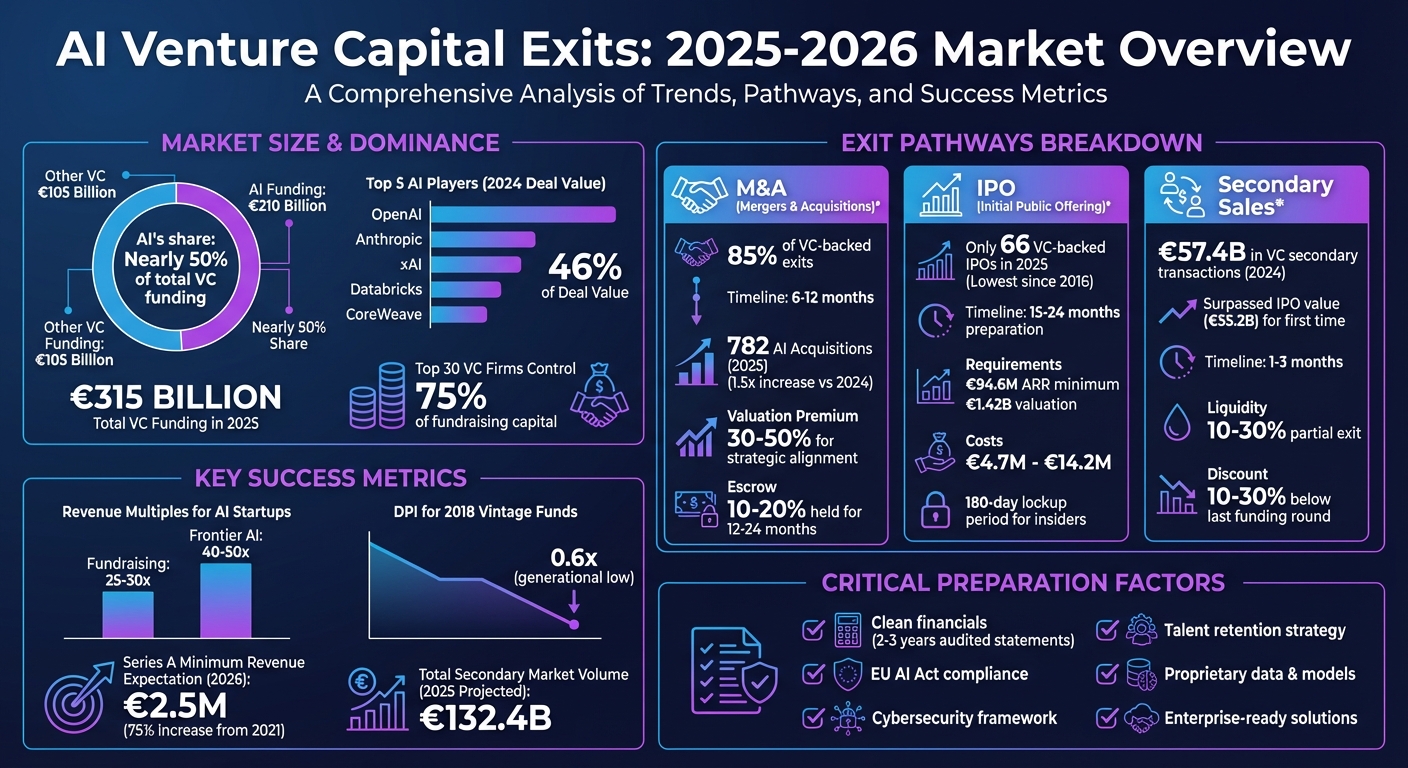
AI Venture Capital Exit Strategies: 2025-2026 Market Data and Success Metrics
Factors That Influence AI Venture Capital Exits
Market Trends and Economic Conditions
The venture capital scene in 2026 paints a challenging picture. Distributions to paid-in capital (DPI) have reached generational lows, with 2018 vintage funds sitting at just 0.6x DPI [8]. This slowdown in exits has led to a form of "cartel consolidation", where the top 30 VC firms now control 75% of fundraising capital. On top of that, five major AI players - OpenAI, Anthropic, xAI, Databricks, and CoreWeave - accounted for a staggering 46% of 2024's venture deal value [8].
While the IPO market is technically still open, it's become highly selective. Only 66 VC-backed IPOs happened in 2025, marking the lowest number since 2016 [8]. At the same time, secondary market transactions surged, hitting approximately €152 billion in 2024. Interestingly, the value of VC secondary transactions - around €57.4 billion - surpassed the total IPO value of €55.2 billion for the first time [8]. This shift underscores a growing trend: traditional IPOs are no longer the go-to exit strategy.
"Venture capital is essentially making a single bet - that AI will deliver massive returns fast enough to justify current funding totals." – CB Insights [6]
Corporate giants are leaning heavily on a "buy over build" approach, fueling a robust M&A market while IPOs remain tight. In 2025, the number of AI acquisitions soared to 782 - a 1.5x jump compared to 2024 [10]. Additionally, tech megacorporations are expected to pour over €282 billion into AI-related investments, including infrastructure and acquisitions, during this cycle [7].
These market dynamics are reshaping the landscape for AI ventures, presenting both hurdles and openings.
AI-Specific Challenges and Opportunities
Exits in the AI sector come with unique complexities compared to traditional software. One major factor is the fierce competition for top talent, often leading to "acquihires" where companies are acquired primarily for their engineering teams. While this strategy helps secure talent, it tends to yield lower returns for late-stage investors [5].
Another challenge lies in valuation discrepancies. AI fundraising rounds often command revenue multiples of 25–30x, but M&A deals typically come in lower due to the added costs of due diligence and integration [11]. For example, Salesforce emerged as the most active AI acquirer in 2025, completing 10 deals, including purchases of Spindle (focused on agent analytics) and Qualified (a marketing automation platform) [10].
"The frontier model race is dividing into the 'haves' and 'have-nots,' with increasing model training costs threatening the viability of smaller players." – CB Insights Research [10]
Regulatory concerns are also pushing investors to explore creative deal structures. In December 2025, Nvidia struck an €18.8 billion licensing and talent agreement with chip startup Groq. This "quasi-acquisition" was designed to avoid triggering antitrust reviews [10]. Similarly, minority stakes and licensing arrangements, like Meta's 49% stake in Scale, are becoming more common, reshaping how AI companies approach exits.
In such a competitive and evolving market, having a solid technological foundation is crucial for successful exits.
Technology's Role in Exit Readiness
The ability to exit successfully in the AI sector now heavily depends on technological strength. In 2026, startups with proprietary data, unique models, and resilient infrastructure are commanding higher valuations by building strong barriers to entry [12]. Companies at the forefront of generative AI and large language model development often achieve revenue multiples of 40–50x, with rare cases exceeding 100x [12].
Preparing for an exit requires more than just a strong AI model. Due diligence now extends to areas like manufacturing, reliability, and deployment readiness [5]. Startups with well-differentiated products and sustainable business models are more likely to secure high-value exits. On the flip side, those lacking product-market fit often wind up as lower-value acquihires [5]. For instance, Anthropic's €14.1 billion funding round in October 2025 - the largest of Q4 - underscores investor confidence in frontier AI models as a path to lucrative exits [4].
Emerging research points to the growing role of AI in optimizing exit strategies. Large language models are now being used to analyze financial data, news, and market signals, helping venture capital investors pinpoint the best timing for exits [13]. This capability is increasingly important as investors navigate a market where retaining technical talent was ranked the top investment risk for AI startups in 2025 [5].
sbb-itb-e314c3b
Exit Strategy Options for AI Startups
Initial Public Offerings (IPOs)
IPOs are often seen as a prestigious milestone but come with considerable demands. By 2025, successful tech IPOs generally required at least €94.6 million in annualised recurring revenue and a valuation of €1.42 billion or more [20]. The preparation process spans 15–24 months and includes filing requirements [15]. Costs for an IPO range between €4.7M and €14.2M, covering expenses like audits, legal fees, and annual compliance [15].
The IPO market in 2026 remains selective. High-profile companies like Circle, Coreweave, Figma, and Klarna returned to the IPO scene in 2025, signaling a cautious reopening for high-value AI startups [19]. However, insiders must comply with a mandatory 180-day lockup period before selling shares [15]. On the plus side, IPOs provide access to vast capital markets and ongoing growth opportunities. On the downside, they bring intense public scrutiny and heavy regulatory obligations. Companies must present 2 to 3 years of audited GAAP/IFRS financial statements, maintain SOX-compliant internal controls, and have an independent board majority [15].
"The IPO market in 2025 is definitely not a free-for-all. It's highly selective. Institutional investors are demanding quality and predictability." – FinancialModelsLab [20]
Mergers and Acquisitions (M&A)
For startups seeking faster liquidity, M&A offers a more immediate alternative to IPOs. In fact, over 85% of venture-backed exits occur through M&A [19]. These deals typically take 6 to 12 months from initial discussions to closing [15], and liquidity is often immediate - though 10% to 20% of the purchase price may be held in escrow for 12 to 24 months [15]. Valuations are negotiated directly with buyers and can include a 30% to 50% premium for strategic alignment [15].
Recent examples highlight this trend. In 2025, Publicis Groupe acquired Lotame to boost its AI capabilities [14]. Vista Equity Partners purchased Nexthink, an AI-driven employee experience platform, for €2.92 billion [16]. Meanwhile, the French State acquired Atos' Advanced Computing division for €410 million, including a €110 million earn-out [14]. These deals illustrate how M&A can serve various goals, from strategic expansion to talent acquisition or even national sovereignty concerns.
While M&A offers quicker liquidity, it often comes at the expense of independence. Many agreements include earn-outs tied to future performance [20]. For AI startups with proprietary data or niche expertise but limited scalability, M&A can be a more practical choice than pursuing an IPO [18].
Secondary Sales and Continuation Funds
For startups not ready for a full exit, secondary sales and continuation funds present alternative options. Secondary transactions, which typically close within 1–3 months, allow partial liquidity of 10–30% without requiring a complete exit [15]. For instance, in February 2025, Stripe held a tender offer at a €86.6 billion valuation, enabling employees and former employees to sell shares without going public [15]. However, these shares often trade at a 10% to 30% discount compared to the most recent funding round [15].
Continuation funds are another growing option. These funds allow private equity firms to return capital to investors while retaining long-term stakes in high-performing AI startups [19]. By 2025, the global VC secondary market volume is expected to reach €132.4 billion [20]. This approach is particularly suited for Series B+ companies looking to provide liquidity without the regulatory complexities of an IPO or the full ownership transfer typical in M&A deals [15].
One drawback of secondary sales is the potential for the market to misinterpret them as a lack of confidence [20]. Nonetheless, they offer a balanced path between remaining private and pursuing a full exit. These diverse strategies allow AI startups to choose the best route based on their market position, technological maturity, and long-term ambitions.
How to Plan AI Venture Capital Exits
Building Startups Ready for Acquisition
Getting an AI startup ready for a successful exit means focusing on more than just flashy branding. Acquirers in 2026 are looking for enterprise-grade AI solutions that deliver real results. This includes advanced AI tailored for business needs, proprietary data, scalable systems, and strong technical barriers to competition - not just surface-level appeal [18][17].
Founders need to establish the reasons behind a potential sale early on. Whether it's to scale up, solve funding challenges, or shift strategy, having a clear "why" helps align co-founders, boards, and investors [18].
To attract buyers, your technology must be well-documented, modular, and production-ready. Acquirers are less impressed by flashy demos and more interested in AI that drives measurable outcomes, such as reducing churn or improving operations [18]. For example, in late 2024, Glean, an enterprise search AI company, hit a €7.2 billion valuation after surpassing €100 million in annual recurring revenue (ARR). This success came from addressing deep enterprise challenges, proving the value of solving real business problems [22].
Another critical step is preparing for due diligence. This means maintaining clean financial records, clear ownership structures, and properly documented intellectual property. Buyers also expect detailed records of how your AI models were trained, where data came from, and the security measures in place [18]. Cybersecurity, in particular, has become a dealbreaker - startups without strong frameworks risk losing value or even failing to close deals [1]. Additionally, compliance with regulations like the EU AI Act is increasingly important [1][18].
By focusing on these foundations, you not only prepare for a smoother exit but also reduce risks tied to market shifts or regulatory changes.
Managing Risks and Uncertainties
Planning an exit means navigating challenges like market fluctuations and evolving regulations. To stay in control, founders should use a structured sale process led by an experienced advisor. This approach helps avoid letting unsolicited offers dictate the company’s valuation or timeline [18]. Instead, creating competition among buyers often leads to better outcomes.
Timing is everything. The best moment to exit is when your company is still experiencing rapid growth. Buyers reward momentum but tend to penalize startups that have started to plateau [21][23]. Founders should also pay attention to consolidation trends in their sector. If competitors are raising large rounds or being acquired, it could signal a shrinking window for exits [21].
Currently, Series A startups are expected to show at least €2.5 million in annual revenue to attract funding or premium exit offers. This marks a 75% increase compared to 2021 [1].
"Consider exiting when further growth demands excessive capital, leadership, or risk." – Transacta Capital [21]
To avoid being forced into a sale, founders should maintain flexibility. This means keeping options open to raise capital, merge, or sell a minority stake. It’s also important to reduce dependency on key individuals, such as founders, by ensuring critical processes and knowledge are well-documented [21].
Leveraging Industry Events for Exit Opportunities
Once your startup is prepared and risks are minimized, networking becomes a crucial step in unlocking the best exit opportunities. One strategy is to target potential buyers - like Microsoft, Alphabet, or Salesforce - as customers first. Building these relationships early can significantly increase the chances of a future acquisition [23].
Industry events are ideal for making these connections. For example, the RAISE Summit in Paris is a major gathering for AI innovation, attracting over 9,000 attendees, 2,000 companies, and 350 speakers each year. The event includes keynote speeches, panel discussions, startup competitions, and networking sessions, all focused on fostering collaboration in AI. Founders looking to exit can use the summit to meet potential acquirers, investors, and partners. VIP passes even offer exclusive access to top industry leaders.
Beyond formal events, embedding yourself in the buyer ecosystem is key. This can involve participating in niche tracks, speaking on panels, or using networking platforms to set up meetings with corporate development teams. Building relationships early positions your startup as a strategic asset, ensuring you’re seen as an opportunity - not a company in distress.
Conclusion: AI Venture Capital Exits in 2026
Key Points for Successful Exits
For AI startups aiming for successful exits in 2026, the focus has shifted from hype to solid fundamentals. Investors and founders need to emphasize capital efficiency, clear profitability strategies, and business models that have already proven their worth [2][3]. With early-stage revenue expectations climbing, showcasing strong financial metrics has become non-negotiable [1].
Mergers and acquisitions (M&A) remain a dominant trend, driven by corporations opting to "buy over build." Meanwhile, the IPO market is cautiously reopening, but only for companies with exceptional quality [4]. Cybersecurity is a critical factor - any lapses can lead to reduced valuations or even failed deals [1]. As Josef Fuss, a Partner at Taylor Wessing, highlights, the current market rewards startups that combine cutting-edge AI technology with solid business fundamentals, leaving hype-based ventures behind [3].
Preparation is key. Startups must ensure their technology stacks are well-documented, financial records are clean, and they comply with regulations like the EU AI Act. Retaining top talent is equally important to preserve value during acquisitions [5][18]. Building early relationships with potential acquirers - whether through events like the RAISE Summit or by turning them into customers - can position a company as a strategic asset rather than a distressed sale.
The Future of AI Exits
The trends shaping AI exits suggest a dynamic future. By 2025, AI companies secured 48% of total venture funding, amounting to €226 billion globally [6]. This concentration of capital reflects a preference for innovators with defensible advantages, particularly in areas like infrastructure, robotics, and industry-specific AI solutions that address tangible enterprise challenges [6][9].
Secondary markets are emerging as a key part of the venture ecosystem, providing alternative liquidity options when IPOs face delays [8]. However, the standards for success are rising. By early 2026, only 5% of organisations reported measurable value from their AI initiatives, leading buyers to scrutinize outcomes more rigorously than ever [24].
To succeed, startups must combine advanced technology with disciplined execution, comply with evolving regulations, and build strong industry connections. Whether through M&A, IPOs, or secondary sales, startups that focus on the fundamentals and plan ahead are well-positioned to seize the opportunities in this evolving landscape.
AI Investors Panel: What Gets Funded (and Exited) Now | TechExits Podcast
FAQs
When should an AI startup choose M&A vs an IPO?
When an AI startup considers its next big move, mergers and acquisitions (M&A) can be a smart choice. This route often helps strengthen capabilities, accelerate entry into the market, or address funding gaps - particularly when the market favours buyers. On the flip side, an initial public offering (IPO) might be better suited for companies boasting robust, scalable revenue streams and aiming for rapid growth through public markets. That said, current trends often lean more toward M&A as the preferred path. The key is to evaluate market conditions thoroughly and align the decision with your long-term objectives.
How do secondary sales work without signalling weakness?
Secondary sales in AI venture capital don't have to signal instability. Instead, they can serve strategic goals like offering liquidity to early investors or founders while keeping the company on its growth trajectory. When handled thoughtfully, these transactions can highlight confidence in the company's value. By addressing liquidity needs, retaining key talent, and avoiding excessive dilution, secondary sales demonstrate a sophisticated approach to managing capital - one that reflects strength and foresight rather than financial strain.
What do buyers check in AI due diligence (data, IP, EU AI Act)?
During the AI due diligence process, buyers focus on several key areas. They examine data provenance to ensure the origins and usage rights of the data are clear. Licensing agreements are reviewed alongside intellectual property rights to confirm there are no legal complications. Buyers also evaluate model security, privacy safeguards, and compliance with regulations such as the EU AI Act.
Additionally, they assess the robustness of the AI model, checking for vulnerabilities, bias, and safety concerns. Ethical considerations are also a priority, ensuring the technology aligns with both legal requirements and moral standards. This thorough review helps facilitate a seamless transaction.