

AI conferences are a goldmine for business leaders navigating the fast-changing AI landscape. With over 78% of organizations integrating AI into their strategies, attending the right event can help you stay ahead. Here's how to pick one that aligns with your goals:
- Define Your Goals: Are you focused on research, deployment, or governance? Choose conferences like NeurIPS for research or AI & Big Data Expo for business applications.
- Assess ROI: Factor in ticket prices (€495–€3,499), travel, and time. Early-bird discounts and virtual options can cut costs.
- Speaker Quality: Look for experts with proven results, not just titles. Prioritize sessions with clear, actionable outcomes.
- Networking: Opt for events with decision-makers and tools like AI-driven matchmaking to maximize connections.
- Logistics: Plan around your schedule and milestones. Hybrid formats offer flexibility but in-person events excel in networking.
The best conference fits your strategy, budget, and schedule while delivering actionable insights. Plan early, review agendas, and prioritize events that meet your organization's needs.
AI Engineer Summit 2025 - AI Leadership (Day 1)
sbb-itb-e314c3b
Setting Your Conference Selection Criteria
Before diving into the sea of AI events in 2026, it's essential to define what you're looking for. Think about your organisation's challenges and strategic goals. Are you aiming to solve production issues with technical solutions? Do you need to compare your AI governance framework with industry benchmarks? Or perhaps you're exploring emerging technologies like agentic AI systems that could reshape your business model? As Piers Grassmann, Associate Account Director at Aspectus Group, wisely points out:
Conferences only create ROI when insights turn into action. Be strategic: map key sessions to business goals, pre-book meetings, and gather insights your teams can use. [5]
The best conference is one that fits your schedule, budget, and allows you to apply what you've learned right away.
Matching Conferences to Your Company's AI Strategy
Not all conferences are created equal, and the right one for you depends on where your organisation stands in its AI journey. If you're in the research and development phase, events like AAAI or NeurIPS are ideal. These conferences focus on peer-reviewed research and theoretical advancements, making them perfect for exploring what's technically possible [5][1].
On the other hand, if your company is scaling up and deploying AI in production, you'll want to focus on business-oriented events. For example, AI & Big Data Expo is known for tackling practical challenges like regulatory compliance, infrastructure scaling, and ROI measurement [5][1].
Your role within the company also plays a big part. AI engineers should look for conferences with deep technical tracks, such as the AI Engineer World's Fair, which offers 20 technical tracks and features 250 speakers focused on production patterns [8]. Meanwhile, product managers might benefit more from sessions on quality evaluation frameworks and systematic measurement approaches [8].
To maximise your experience, review conference agendas well in advance - ideally six months before the event. Look for workshops or sessions that align with your team’s needs, whether it’s prompt engineering for LLM implementation or governance and ethics discussions for compliance [4][8].
Once you’ve identified the right conference, take time to calculate the investment and potential return.
Calculating ROI and Budget
Attending a conference isn’t just about the ticket price - it’s an investment that includes travel, accommodation, and the time spent away from regular work. For 2026, ticket prices for major AI conferences in Europe and North America range from approximately €495 for early bird tickets at events like the AI & Big Data Expo Global in London to €3,499 for VIP MAX passes at premium summits [2].
To make the case for this investment, outline how the conference will directly benefit your organisation. Will it help you evaluate vendors more effectively? Offer actionable ROI frameworks? Or connect you with potential partners? [1][8]
Take a cue from companies like Cloudinary, which measured the ROI of their flagship event, ImageCon, by tracking retention and cross-sales metrics. They found that attendees showed notable improvements in these areas, contributing directly to revenue through closed deals [9]. Similarly, Drift’s virtual event series generated over 36,000 registrations, influenced more than 300 sales opportunities, and added €1.3 million to their pipeline [9].
If budget is a concern, consider hybrid or virtual attendance options. Virtual passes cut travel costs and allow multiple team members to participate, while key leaders can attend in person for networking [1][7]. Early bird discounts can also make a significant difference, with some conferences offering up to 56% off when you register six months ahead [8].
Once the financials are sorted, it’s time to think about how to fit the conference into your schedule.
Managing Time and Schedule Conflicts
Even the most valuable conference won’t help if you can’t attend or if it disrupts critical business operations. Look ahead to 2026 and identify key milestones - like product launches, board meetings, or financial reporting periods - to plan your attendance without causing disruptions [5].
To make the most of your time, schedule meetings and secure speaking slots early. Use event apps and platforms like LinkedIn to connect with key attendees before the conference starts, reducing the need for last-minute arrangements [5].
Fortunately, many major conferences now offer hybrid formats, making it easier to balance attendance with ongoing work. For example, Q1 features events like AAAI in Singapore, AI & Big Data Expo in London, and NVIDIA GTC in San José. Q2 brings HumanX in San Francisco and Google Cloud Next in Las Vegas. Q3 includes Ai4 in Las Vegas, and Q4 wraps up with World Summit AI in Amsterdam [2][8].
To stay productive during multi-day events, plan a balanced schedule that includes breaks and recovery time. Prioritise sessions based on their relevance to your goals, categorising them as "high priority", "flexible", or "must attend." This ensures you get the most value from the sessions that matter most to your organisation’s objectives [11].
Evaluating Speakers and Content Quality
Once you’ve narrowed down your conference options, it’s time to dig deeper into the speakers and the content to ensure you’ll walk away with actionable insights.
Checking Speaker Credentials and Industry Experience
Focus on speakers with a proven track record - those whose achievements are backed by tangible results like published research, successful projects, or industry accolades [12][13]. It’s not just about titles; it’s about real-world experience and operational success.
Look for speakers who are builders, not just talkers. CTOs, lead data scientists, and founders who’ve faced real challenges often provide more practical advice than those who focus solely on theory [16][5]. For instance, the RAISE Summit features over 350 speakers, with 80% of attendees being C-level executives and founders. This ensures that many sessions are led by individuals who’ve tackled the same decisions you might be facing [6]. Eric Schmidt, former CEO of Google, even described it as:
The fastest-growing AI Tech conference in Europe, and maybe in history [6].
But it’s not just about expertise. Pay attention to whether speakers can break down complex AI topics into clear, digestible insights without losing technical accuracy. Communication skills are just as critical as knowledge [12].
Reviewing the Agenda for Depth and Relevance
Once you’ve vetted the speakers, turn your attention to the agenda. Does it offer depth and actionable insights, or is it filled with generic buzzwords?
Look for session titles that promise clear outcomes. For example, topics like "0-75M ARR in 7 Months" or "The ROI Dilemma" are far more compelling than vague titles like "The Future of AI" [15][17]. High-quality conferences often organise their sessions around structured frameworks. One example is the "4F Compass", which categorises sessions into Foundation (infrastructure), Frontier (applications), Friction (ROI and compliance challenges), and Future (long-term vision) [15].
A strong agenda should balance big-picture strategy discussions with workshops that deliver hands-on, actionable insights [14][16]. If your organisation operates in a niche field like life sciences, genomics, or real estate, look for sessions that dive deep into those areas rather than offering broad, one-size-fits-all AI applications [14].
Finding Practical Learning Sessions
Great content is essential, but the real value often comes from hands-on learning opportunities that you can apply immediately.
Seek out conferences that include interactive elements like workshops, live demos, hackathons, and case studies with clear, measurable results [14][2]. For example, the RAISE 2026 Global AI Hackathon brings together over 8,000 participants in a hybrid format, offering a €200,000 prize pool. Events like this highlight a commitment to practical application [6].
Additionally, look for vendor-neutral sessions that focus on operational strategies, such as AI governance, compliance challenges, and ROI measurement. These sessions provide frameworks you can implement right away [15][9].
Assessing Networking Opportunities
Networking is a cornerstone of any conference experience. Beyond the insights shared by top speakers, the real value often lies in the connections you make. The right audience mix can lead to partnerships, fresh perspectives, and opportunities that no keynote alone can deliver.
Analysing Attendee Profiles
When choosing a conference, take a close look at the attendee profiles. Prioritise events that attract decision-makers, particularly C-level executives and founders. These gatherings foster meaningful, peer-level discussions. For instance, the RAISE Summit 2026 anticipates over 9,000 attendees from more than 2,000 companies, with over 80% of them being high-level executives and founders [16].
Another indicator of attendee quality is the calibre of speakers and sponsors. If major industry players are involved, it’s a strong sign their peers will be present too [19]. Additionally, many events now use AI-driven matchmaking tools. These platforms analyse registration details, interest tags, and user activity to suggest connections that align with your goals [18]. This approach ensures that your networking efforts are targeted and efficient.
Comparing Formal and Informal Networking Formats
A well-structured conference blends formal networking opportunities with informal interactions. Formal options like roundtables, matchmaking sessions, CxO summits, and exclusive VIP dinners create spaces for high-impact discussions among industry leaders [16]. These settings often lead to strategic conversations and potential deals that go beyond the scope of general sessions.
On the other hand, informal moments - whether during coffee breaks or at casual mixers - can lead to surprising and valuable connections. Research shows that expanding your network beyond familiar circles can significantly enhance professional growth [20]. To make the most of these encounters, follow up within 24–48 hours while the interaction is still fresh. This simple step can turn a fleeting conversation into a lasting professional relationship [20].
Benefiting from Geographic and Industry Mix
The diversity of attendees - across both geography and industries - plays a crucial role in shaping the perspectives you gain. Global conferences provide insights into international trends, while regional events help you build local connections. Together, they offer a well-rounded view of global AI developments [7].
It’s also worth checking whether the event includes policymakers, regulators, or civil society representatives. Their presence can signal discussions around forward-thinking governance [16]. Similarly, consider whether the conference offers a mix of industry-specific tracks or focuses on a single sector. A diverse industry representation can broaden your understanding of how AI is applied across various fields.
Reviewing Logistics and Practical Details
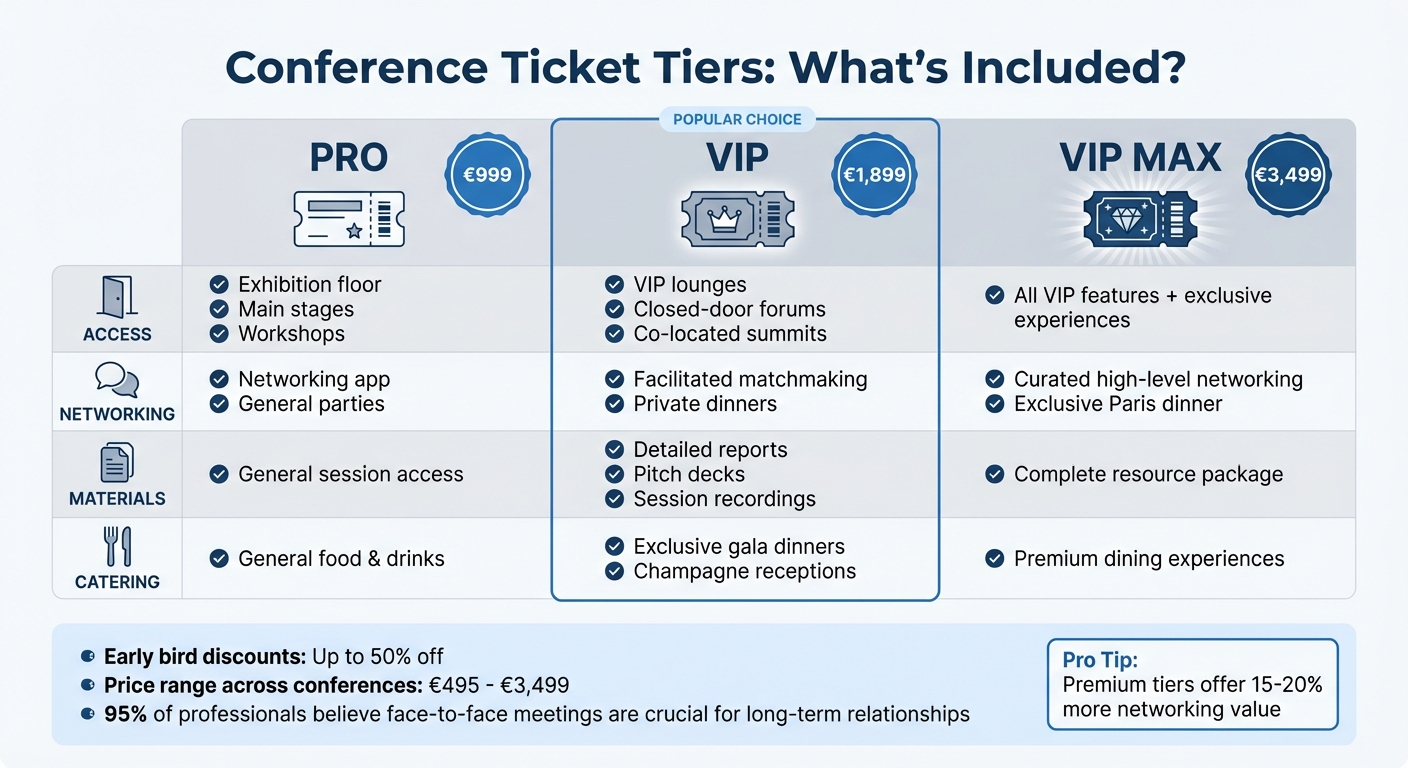
AI Conference Ticket Tiers and Benefits Comparison Guide
Once you've assessed the speakers and networking opportunities, it's time to dive into the logistical aspects of the conference. Details like the venue's location, ticket inclusions, and event format can make or break your experience. Here's how to ensure everything runs smoothly.
Checking Venue Location and Travel Requirements
The venue's location is more than just a pin on a map - it can affect your travel costs, the event's focus, and even the type of people you'll meet. For example, conferences in cities like Munich or Amsterdam often center around regulatory topics like the EU AI Act[21], while San Francisco events tend to attract top-tier engineering talent[21]. Make sure the location aligns with your goals.
For larger conferences, booking early is essential. High-demand events often offer bundled packages to simplify planning. For instance, some tickets - priced at around €3,249 - include registration, two nights of accommodation, and meals[21].
The venue size also plays a role in shaping your experience. Massive spaces, like the Singapore EXPO, can host thousands of attendees and offer extensive networking areas. On the other hand, smaller venues, such as hotels, create a more intimate atmosphere[21][8]. Some events attract over 68,000 participants, while others focus on smaller, high-level crowds with more than 60% VP-level attendees[21].
Exploring Virtual and Hybrid Attendance Options
Event formats have evolved, with hybrid options now being a common choice. But whether virtual or in-person attendance is better depends on your goals. If you're attending to gain knowledge from specific sessions, virtual participation can be effective. However, for networking and building relationships, face-to-face interactions are often unmatched.
Consider this: one conference reported 25,000 in-person attendees versus 300,000 virtual participants[21]. Research suggests that in-person teams generate 15% to 20% more ideas than virtual ones tackling the same problems[22][23]. Jonathan Levav, a marketing professor at Stanford, explains:
If your visual field is narrow, then your cognition is likely to be as well. For creative idea generation, narrowed focus is a problem.[22]
Virtual attendance is budget-friendly and often includes recorded sessions for later viewing. Some events even offer free virtual access, while premium in-person passes can cost up to CHF 4,900 for a Leaders Pass[21]. This flexibility lets you test the waters before committing to in-person attendance.
That said, if your goal is to build partnerships or engage in high-level brainstorming, in-person attendance is worth prioritizing. A survey found that 95% of professionals believe face-to-face meetings are crucial for forming long-term workplace relationships[23].
Comparing Ticket Prices and Included Benefits
Ticket pricing and inclusions vary widely, so choose a tier that aligns with your objectives. Premium tickets often come with perks designed to enhance networking opportunities. For example, the RAISE Summit 2026 offers three tiers:
- PRO (€999): Includes access to sessions, workshops, the networking app, and food and drinks throughout the day.
- VIP (€1,899): Adds access to a VIP lounge and curated networking experiences.
- VIP MAX (€3,499): Includes all VIP features plus an exclusive dinner in Paris[24].
Booking early can save you money, with some events offering nearly 50% discounts for early bird tickets[26][4]. Be aware that prices often increase significantly after the early deadline.
High-value tickets frequently include extras like session recordings, AI trend reports, and startup pitch decks - resources that extend the event's value long after it ends[24][26]. Some conferences even offer matchmaking services, such as "VentureConnect" for startups or "SolutionBridge" for buyers, to facilitate partnerships[26].
If you're on a tight budget, look for free or low-cost options. Many events offer complimentary online access or expo passes, letting you evaluate the content before investing in a premium ticket for future editions[25][26].
| Ticket Feature | Standard/PRO Tier | VIP/Executive Tier |
|---|---|---|
| Access | Exhibition floor, main stages, workshops | VIP lounges, closed-door forums, co-located summits |
| Networking | Networking app, general parties | Facilitated matchmaking, private dinners |
| Materials | General session access | Detailed reports, pitch decks, session recordings |
| Catering | General food & drinks | Exclusive gala dinners, champagne receptions |
Your choice of ticket should reflect your goals. If you're there to soak up knowledge, a standard pass might be enough. But if you're aiming to connect with decision-makers or secure partnerships, investing in a premium tier can provide the access and opportunities you need to make the most of the event.
Checking Conference Credibility
Before dedicating your time and resources to a conference, it's essential to confirm its credibility. A trustworthy conference typically shares measurable outcomes and provides access to archived materials, such as recordings of past keynote speeches and sessions [17].
Investigating Past Events
A conference’s track record can reveal a lot about its credibility. Take the RAISE Summit 2025 in Paris as an example - it attracted 822 CEOs from 168 Fortune 500 companies and investors collectively managing over €570 billion in assets [28][29]. Reputable conferences often make past session recordings available, allowing you to assess the quality of their content [17]. These events usually feature a mix of influential policymakers, established tech leaders, and groundbreaking startups [28].
To further gauge a conference's reputation, look for verified attendee reviews on platforms that evaluate events based on their return on investment (ROI) and content quality. For instance, some top-rated AI summits in 2025/2026 boast Eventible Scores as high as 4.69/5 [9]. Academic conferences, on the other hand, often establish credibility through rigorous peer-review processes, with acceptance rates frequently falling below 25% [1].
Reviewing Organiser Background and Partners
A conference's organisers and their partnerships can be strong indicators of its legitimacy. Established research institutions, professional associations like AAAI, or industry leaders such as NVIDIA and Databricks are often behind reputable events [1][5]. Collaborations with major tech companies further demonstrate the event’s standing within the industry [29][16].
Government endorsements can also add weight. Support from high-ranking officials, like a Minister of Artificial Intelligence, signals institutional trust and relevance [29][10]. Similarly, academic partnerships with leading universities and AI departments reflect a commitment to scientific depth over purely commercial interests [10].
The speaker lineup can also provide clues. Look for alignment between the speakers and the event's partners. For example, Eric Schmidt, Former CEO & Chairman of Google, once described an event as:
the fastest-growing AI tech conference in Europe, and perhaps in history [29].
Likewise, Jonathan Ross, Founder and CEO of Groq, highlighted:
RAISE is where everyone in AI is going [29].
Verifying Clear Event Information
Once you’ve assessed the event’s history and partnerships, check that its details are transparent and well-organised. Credible conferences outline important dates - such as submission deadlines and registration timelines - clearly and well in advance [1]. Vague or frequently changing details can be red flags.
High-quality conferences often provide Continuing Professional Education (CPE) credits, indicating that the sessions have been formally vetted [27]. They also prioritise practitioner-led discussions over sales-heavy presentations, maintaining vendor neutrality [9][8]. For technical events, look for agendas that include in-depth sessions like code-level demonstrations, architecture deep dives, and debugging workshops - not just broad, high-level panels [8].
Additionally, credible organisers often promote diversity and accessibility by offering scholarships, student volunteer roles, and grants for early-career researchers [1]. Structured networking opportunities, such as exclusive CxO summits for Fortune 1000 executives, are another hallmark of a well-organised event [29]. If an event lacks transparency about its programme, speakers, or logistics, it’s best to consider other options.
These checks, combined with earlier evaluations of speakers, networking opportunities, and logistics, can help ensure that the conference aligns with your goals.
| Conference Type | Key Credibility Indicator | Examples |
|---|---|---|
| Academic Research | Peer-review acceptance rates < 25% | NeurIPS, ICML, AAAI |
| Industry-Focused | Partnerships with global tech giants | NVIDIA GTC, AI Summit London |
| Practitioner/Engineer | Code-level demos and failure analysis | AI Engineer World's Fair |
| Leadership/Strategy | High percentage of C-suite attendees | RAISE Summit, Gartner Summit |
Once credibility is confirmed, you can confidently move forward with your conference planning.
Conclusion: Making Your Conference Choice
After evaluating the criteria, speakers, networking opportunities, and logistics, it’s time to select the conference that aligns best with your AI goals. Start by defining your main objective. Are you aiming to stay updated on the latest research, find collaborators for a specific project, or explore practical business solutions? The format plays a role, too - attending in person offers better opportunities for spontaneous networking, while virtual events provide a more cost-effective way to access specific sessions [1].
Once you've made your choice, focus on turning insights into action. Arrive prepared with 2–3 key challenges to discuss with speakers and peers. Schedule meetings with potential collaborators ahead of time, and after the event, establish a task force to pilot at least one project inspired by what you’ve learned [3].
Budget planning is also essential. Early registration can help you save significantly. For instance, RAISE Summit 2026 offers PRO passes starting at € 999 (excluding VAT), VIP packages at € 1 899, and discounted rates of € 599 for eligible developers and startups.
Ultimately, the ideal conference fits seamlessly into your company’s AI strategy and provides insights you can act on right away. Use the guidance in this article - credibility checks, speaker evaluations, and networking assessments - to make a choice that supports both your personal growth and your organisation’s progress in AI.
FAQs
How do I pick one AI conference if I can only attend one?
To pick the best AI conference, start by ensuring it aligns with your objectives and offers genuine value. Check if the agenda matches your interests and if the target audience fits your professional network. Networking opportunities can be a key factor, so consider what connections you might make. Think about the format - whether it's in-person, hybrid, or virtual - and whether the location is practical for you. Prioritise events featuring well-known speakers and sessions that delve into topics you're passionate about, like enterprise AI or ethical AI. This way, you can make the most of your time and grow professionally.
What ROI metrics should I track after the conference?
Track important metrics like attendee participation, networking results, lead generation, brand visibility, session engagement, and post-event follow-up meetings. These measurements provide insight into how well the conference aligns with your objectives and help assess its overall return on investment.
How can I make networking actually lead to deals or pilots?
Networking at AI conferences can become the gateway to deals or pilot projects if approached with purpose and strategy. The key lies in engaging meaningfully - have tailored conversations that resonate with others' interests and needs. Once connections are made, follow up promptly to keep the momentum alive.
Make the most of opportunities like roundtables, private lounges, or exclusive gatherings, where you can have focused discussions. Preparation is crucial: define your goals, research the key attendees, and craft pitches that align with the event's vibe and your objectives. Events like the RAISE Summit are especially valuable, offering curated sessions that encourage in-depth discussions, paving the way for partnerships or actionable outcomes.