

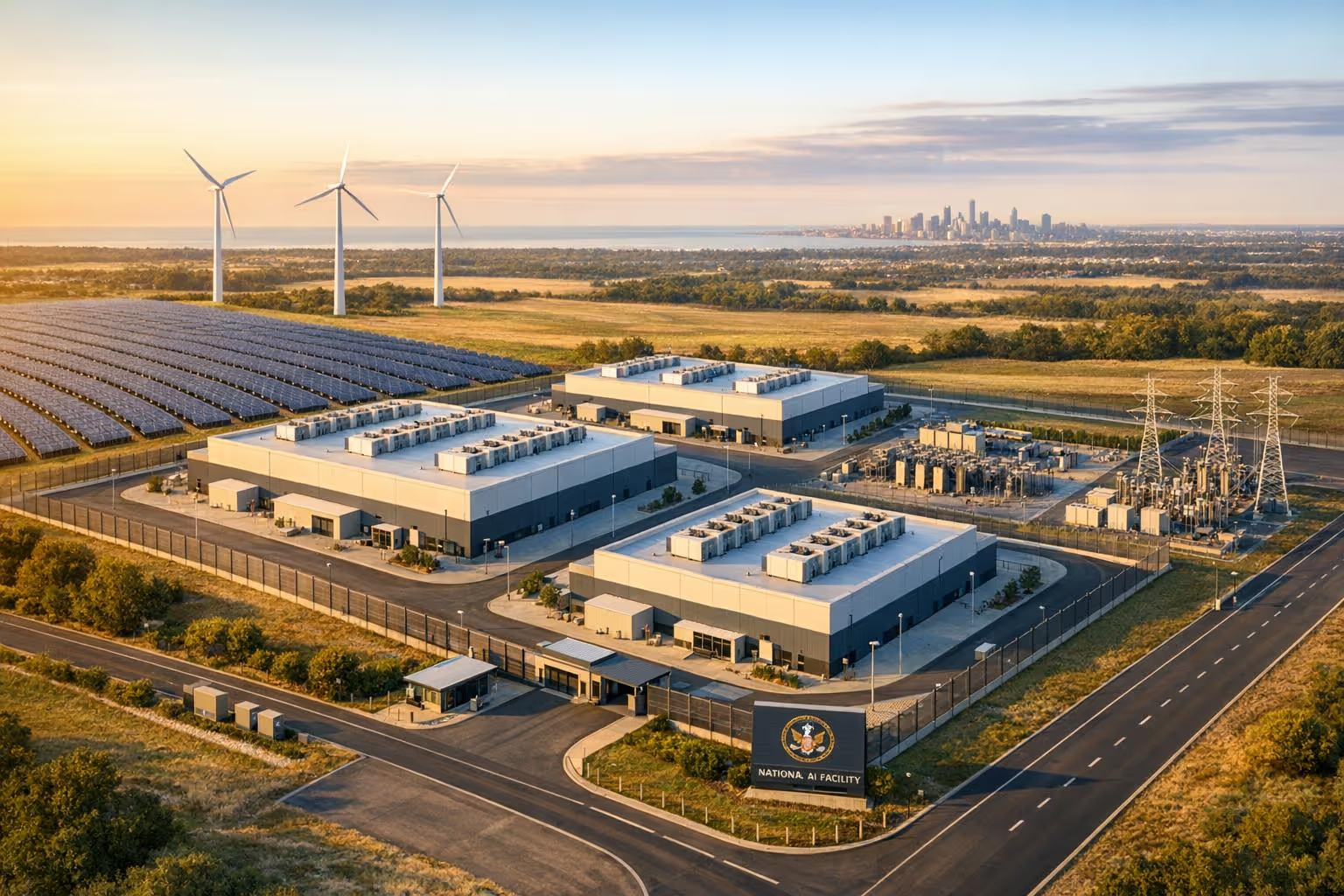
Nations are investing heavily in AI infrastructure to secure economic independence, protect sensitive data, and maintain control over critical technologies. By 2026, global spending on sovereign AI systems is projected to surpass $100 billion, with countries like France leading the charge through massive investments in GPUs, data centres, and energy-efficient compute systems.
Here's why this shift matters:
- Sovereign AI ensures countries can develop and control AI systems aligned with local values, avoiding reliance on foreign providers.
- Compute capacity - data centres, GPUs, and supercomputers - is central to training advanced AI models. Without it, nations risk falling behind in innovation.
- Energy challenges are driving countries to leverage low-carbon power sources like nuclear and hydroelectric energy for AI infrastructure.
- France, under the France 2030 plan, has committed €109 billion to AI infrastructure, aiming to deploy 1.2 million GPUs and train 100,000 AI professionals annually by 2030.
France is also leveraging its nuclear energy to power AI supercomputers, with projects like a €10 billion decarbonised data centre in partnership with Fluidstack. These initiatives, coupled with strict data residency rules, are positioning France as a leader in AI sovereignty while adhering to European standards.
Key takeaway: Sovereign AI is not about isolation but resilience - balancing local control with global collaboration to safeguard data, boost innovation, and ensure long-term competitiveness.
Sovereign AI: Why Nations Are Building Their Own Models
sbb-itb-e314c3b
France's AI Infrastructure Investments

France's €109 Billion AI Infrastructure Investment Breakdown and Key Targets by 2030
France is making bold moves to establish itself as a global leader in AI. In February 2025, President Emmanuel Macron announced €109 billion in total investments dedicated to AI infrastructure and projects [3]. This ambitious plan combines funding from the France 2030 initiative with significant private and international contributions, making it one of the largest AI strategies in Europe.
At the heart of this initiative is a focus on sovereignty. Macron emphasized the importance of building independent computational capacity, free from reliance on foreign cloud providers:
"This is our fight for sovereignty, for strategic autonomy. We want our cloud, we want our data centres, we want our computing capacities." [3]
The goal is clear: to position France as a leading global AI hub while adhering to European values and regulatory frameworks. By treating compute as critical infrastructure, France is signaling its commitment to both innovation and independence.
France 2030 Plan: €109 Billion Investment in Technology
The France 2030 plan is a cornerstone of this strategy, allocating €2.22 billion specifically for AI research and development within the broader €109 billion framework [3]. This funding is divided into three phases:
- Phase 1 (2018–2022): Focused on foundational research, with €1.5 billion invested.
- Phase 2 (2022 onward): Prioritizing innovation acceleration, with €1 billion allocated.
- Phase 3: Aiming to integrate AI widely across society and industries [8].
In addition to domestic funding, strategic foreign investments are bolstering the ecosystem. Contributions include €30–€50 billion from the UAE, €20 billion from Brookfield, and €5 billion from Digital Realty [3][6][7]. This diversified funding approach strengthens France’s self-reliance while maintaining its appeal to global partners.
France’s hardware goals are equally ambitious. By 2030, the country aims to deploy 1.2 million GPUs and achieve 1.5 GW of compute capacity [9]. To support these advancements, the plan also includes training 100,000 individuals annually in AI skills by 2030, a significant increase from the current 40,000 [8].
Nuclear-Powered Supercomputers by 2026
France is leveraging its robust nuclear energy infrastructure to power its AI ambitions. With 57 reactors generating 61 GW of capacity and supplying 60% to 75% of the country’s daily electricity [11], this low-carbon energy source is ideal for the energy-intensive demands of AI. Macron highlighted this advantage:
"We have a role to play because our nuclear energy is controllable, safe, stable, and decarbonised - ideal for expanding our AI computing capabilities." [4]
In February 2025, UK-based AI cloud provider Fluidstack partnered with the French government to develop one of the world’s largest decarbonised AI supercomputers. This project, starting with a €10 billion investment, will host 500,000 next-generation AI chips. Phase 1, set to be operational by 2026, will deliver 1 GW of compute power, with plans to expand further by 2028 [4][10]. French officials Eric Lombard and Marc Feracci, alongside Fluidstack President César Maklary, signed the agreement. Maklary praised France’s commitment, stating:
"France's commitment to digital and energy sovereignty makes it the ideal location for such an ambitious project." [4]
EDF has already identified four potential sites with 2 GW of power for data centre development [4]. To streamline the process, the government is working on legislation to classify data centres as "projects of major national interest", reducing planning approval times from 18 months to nine months [11].
Sustainability is also a key focus. Future facilities will incorporate waste heat recovery systems, following the model of the Jean Zay supercomputer, which already uses its waste heat to warm over 1,500 homes in the Saclay area [5]. This approach not only reduces environmental impact but also maximizes energy efficiency on a large scale.
France's AI Infrastructure in Action: Mistral AI and Beyond
France's efforts to establish a sovereign AI strategy are yielding practical results. These initiatives demonstrate how the nation is turning policies into operational AI infrastructure that strengthens both its economy and national security. With a €109 billion investment, France is building systems that serve critical industries while ensuring data remains under its control.
Mistral AI: €1.7 Billion Boost for Infrastructure
In September 2025, Paris-based Mistral AI secured an impressive €1.7 billion in Series C funding [3]. Leading the investment was Dutch semiconductor leader ASML, contributing €1.3 billion for an 11% stake, making it Mistral AI's largest shareholder [3]. This funding allowed the launch of Mistral Compute, an AI infrastructure stack designed to eliminate reliance on foreign cloud providers.
The backbone of this initiative is a 40 MW data centre located in Essonne, equipped with 18,000 NVIDIA Grace Blackwell and Blackwell Ultra GPUs [3]. This facility offers a full suite of services, including bare-metal servers, proprietary orchestration software, APIs, and managed Platform-as-a-Service environments [3].
"We are forging Europe's AI future in partnership with NVIDIA, combining strategic autonomy with our expertise in AI and NVIDIA's most advanced technology."
- Arthur Mensch, CEO, Mistral AI [5]
Future plans include expanding the data centre's capacity to 100 MW [13].
Major clients such as BNP Paribas, Orange, and Thales rely on this infrastructure, particularly because it guarantees strict data residency within French borders [12]. This ensures sensitive data remains locally controlled, a critical factor for industries requiring high levels of security and privacy [3].
This powerful infrastructure is paving the way for secure, advanced AI deployments in sectors where data integrity is non-negotiable.
SecNumCloud: Security for Regulated Industries
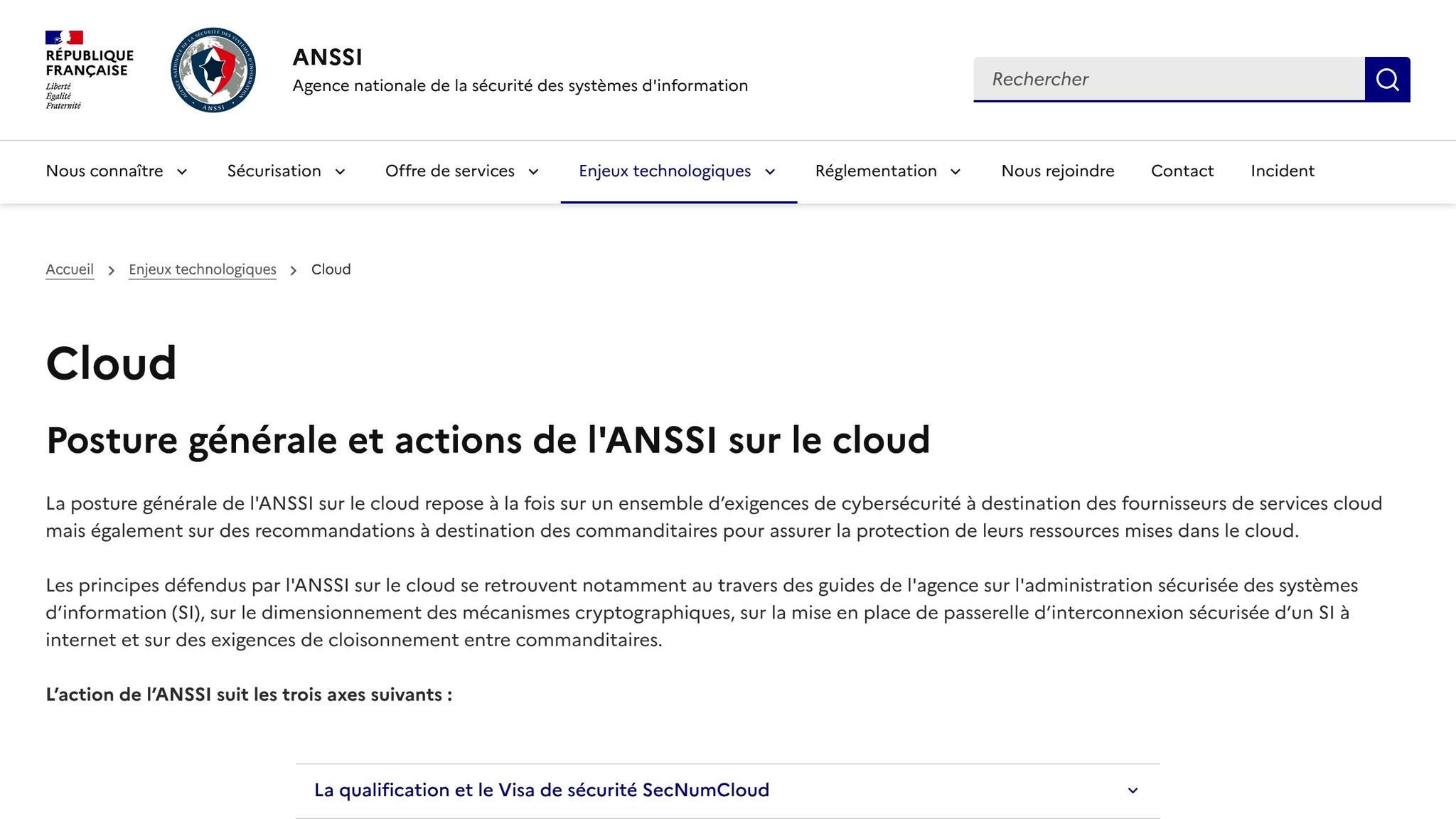
France's AI infrastructure is tailored for sectors where data security is critical. SecNumCloud 3.2, the government's highest security standard for cloud services, is mandatory for public sector organisations, as well as defence, healthcare, and financial institutions [3].
In September 2025, OUTSCALE, a subsidiary of Dassault Systèmes, incorporated Mistral's "Le Chat" assistant into its SecNumCloud 3.2-certified environment [3]. This integration allows government agencies and other regulated entities to use generative AI while meeting rigorous national security and GDPR compliance standards [3]. The certification ensures protection from foreign data access laws, safeguarding sensitive information.
Practical applications highlight the benefits of this infrastructure. For example, SNCF Gares&Connexions, France's national rail operator, deployed AI digital twins powered by NVIDIA Omniverse and Mistral models across 3,000 stations. The Monaco–Monte-Carlo station alone achieved remarkable results: a 100% success rate in preventive maintenance, a 50% reduction in downtime, and a 20% drop in energy consumption [5].
These examples showcase how France is leveraging secure AI to drive efficiency and innovation in critical sectors.
The EU AI Act and Global Competition
The European Union's AI Act is more than just another set of rules - it’s a game-changer in the global race for technological leadership. For France, this legislation presents both opportunities and hurdles as it navigates a middle ground between the dominance of U.S. tech giants and China’s state-driven innovation.
Risk Classifications and Data Residency Requirements
Under the EU AI Act, AI systems are classified based on their risk levels. High-risk applications - those tied to critical areas like infrastructure, healthcare, law enforcement, and financial services - must adhere to strict rules around transparency, data governance, and local oversight. This framework benefits French providers who focus on "architectural" compliance, which goes beyond simple contractual assurances[3].
French sovereign providers, such as Scaleway, OVHcloud, and OUTSCALE, ensure that data remains under EU jurisdiction. This approach guarantees compliance with European legal standards, keeping data fully within French control.
The impact of these regulations is already visible. Managed services in France experienced a staggering 142% year-on-year growth in Q2 2025, as industries subject to regulation increasingly turned to sovereign solutions. Additionally, the SecNumCloud 3.2 certification - France’s top security benchmark - remains out of reach for U.S. hyperscalers unless they collaborate with local firms[1].
These regulatory advantages are shaping France's strategy in the global AI landscape.
Macron's "Third Way" Between US and China
President Emmanuel Macron has articulated a bold vision for AI, one that strikes a balance between reliance on U.S. technology and Chinese state control. His "Third Way" is a strategy designed to position AI as a cornerstone of France’s national sovereignty.
"This is our fight for sovereignty, for strategic autonomy. We want our cloud, we want our data centres, we want our computing capacities." - President Emmanuel Macron[3]
At the February 2025 AI Action Summit, Macron doubled down on this vision, emphasizing a blend of domestic innovation and international collaboration. France’s strategy includes fostering homegrown champions like Mistral AI while pursuing strategic partnerships, such as a massive investment in a 1-gigawatt AI data centre with the UAE, valued between $30 billion and $50 billion[14]. This agreement introduces the concept of "virtual data embassies", allowing for collaborative yet sovereign AI infrastructure.
While the U.S. leans on diplomatic alliances and China relies on state funding[15], France’s Third Way seeks to build European autonomy without sacrificing jurisdictional control. This balanced approach highlights France’s determination to carve out its own space in the global AI arena.
What RAISE Summit Attendees Need to Know

How Sovereign AI Affects Tech, Defense, and Healthcare
Sovereign AI is transforming regulated industries by moving beyond simple contractual compliance to a more rigorous architectural approach. In sectors like healthcare, defense, and technology, this shift is becoming essential for maintaining market access.
In healthcare, sovereign cloud solutions are enabling Edge AI to process sensitive patient data directly at the point of care, avoiding cross-border transfers. A stark example is HCA International's £200,000 penalty for mishandling patient data transfers[16]. French healthcare providers are now using sovereign infrastructure to deploy AI tools for breast cancer detection, which have reduced false positives by 37.3% and biopsy requests by 27.8%, all while ensuring data stays within national borders[16]. This localized approach not only strengthens data privacy but also drives better patient outcomes.
The defense sector has even greater demands for secure and high-performance computing. National investments in sovereign infrastructure, such as Mistral Compute, provide defense contractors like Thales with secure access to high-performance computing without exposing operations to foreign legal risks[3]. France is also advancing its national security capabilities by building Europe’s most powerful classified supercomputer, further solidifying the importance of sovereign AI in defense[2].
For technology companies, the choice of infrastructure is becoming a make-or-break decision for market viability. France’s SecNumCloud 3.2 certification, which U.S. hyperscalers cannot achieve without local partnerships, has created a competitive edge for local providers. Companies like Scaleway, OVHcloud, and OUTSCALE are now offering NVIDIA Blackwell GPUs under EU jurisdiction, enabling compliant and scalable operations for regulated industries[3].
Networking and Partnership Opportunities at RAISE Summit
The sector-specific advancements driven by sovereign AI are creating fertile ground for collaboration at the RAISE Summit. With over 9,000 attendees and 350+ speakers convening at the Carrousel du Louvre, the summit offers an unparalleled platform for organisations to align global ambitions with European compliance standards. France’s €109 billion investment in AI infrastructure underscores these opportunities, reinforcing the country’s push for technological autonomy.
Regulated industries should focus on engaging with providers holding SecNumCloud 3.2 certification, such as OUTSCALE, which has integrated Mistral’s "Le Chat" assistant into its sovereign offerings[3]. For pan-European operations, adopting a multi-cloud strategy that blends French sovereign infrastructure with regional solutions can provide resilience while maintaining jurisdictional control. Meanwhile, healthcare startups can connect with sovereign cloud providers to ensure compliance with NHS procurement requirements, especially as UK GDPR violations carry fines as high as £17.5 million or 4% of annual turnover[16].
Networking opportunities at the summit go beyond vendor discussions. Attendees can explore partnerships with initiatives like S3NS (Google/Thales) or Bleu (Microsoft/Orange), both designed to meet strict French public sector standards[1]. For AI model developers, the chance to interact with Mistral AI representatives offers valuable insights into leveraging 18,000 NVIDIA Blackwell GPUs through sovereign infrastructure. BNP Paribas, for instance, has already demonstrated large-scale deployment of such solutions[3].
"Sovereignty isn't how many petaflops you own. It's how many lives you improve and how fast the economy grows." - Cathy Li, Head of the Centre for AI Excellence, World Economic Forum[17]
This mindset should steer discussions at the RAISE Summit. Instead of striving for complete independence, attendees are encouraged to focus on building resilient dependence - a strategy that allows organisations to adapt when geopolitical conditions, export controls, or vendor policies change[18]. Key steps include mapping digital dependencies, stress-testing for regulatory shifts, and determining which workloads require sovereign infrastructure versus those that can utilize global hyperscalers. With France’s €109 billion AI investment through 2030, the summit offers a unique chance for organisations to position themselves for long-term success[3].
FAQs
What counts as “sovereign AI” in practice?
In essence, “sovereign AI” refers to a country maintaining control over its AI systems, data, and infrastructure entirely within its own borders. This involves storing data locally, hosting AI models on domestic servers, and relying on computing resources - such as cloud services and data centres - that operate under national regulations. The aim is to safeguard data sovereignty, adhere to local laws, and minimise dependence on foreign infrastructure, thereby strengthening both economic security and technological self-reliance.
Which workloads really need sovereign compute?
Workloads that call for sovereign compute typically handle sensitive data, proprietary AI models, or critical infrastructure. These workloads must adhere to strict local rules regarding data residency, security, and governance. Examples include storing data within a specific country, hosting AI models locally, and running applications that demand high levels of data privacy - such as those used in government or defense sectors. This approach ensures compliance with regulations, strengthens security, and supports strategic independence while reducing exposure to geopolitical risks.
How can countries power AI compute without raising emissions?
Countries have an opportunity to cut emissions from AI computing by focusing on renewable energy sources and energy-efficient infrastructure. One approach is the use of distributed micro-datacenters powered by renewable energy. These centers can adjust workloads dynamically, aligning operations with the availability of green energy.
Governments are also prioritizing investments in sustainable data centers, which integrate grid-level controls to optimize energy consumption. These efforts not only reduce emissions but also improve energy efficiency across the board.
In addition, strategic policies and international cooperation play a crucial role. By working together, nations can ensure that AI computing supports global climate goals while maintaining economic competitiveness.